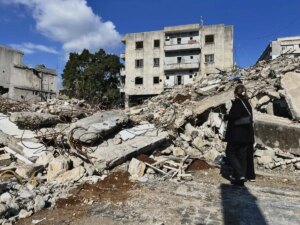
Member of the “Loyalty to the Resistance” bloc, MP Hassan Fadlallah, confirmed that the combined strength of the resistance, its steadfastness, its sacrifices, and the steadfastness of its people, in addition to the regional equation drawn up by the Islamic Republic of Iran, will eventually force Israel to withdraw from Lebanese territory, and enable the people to return and rebuild the destroyed villages and towns.
Fadlallah’s statements came during a celebration held by Hezbollah for a group of martyrs on the second anniversary of their martyrdom, which was held at the Imam al-Mujtaba complex in the Saint-Thérèse region, in the presence of a crowd of scholars, activists, figures, families of the martyrs, and families.
Fadlallah stressed the impossibility of separating Lebanon from the causes and developments of the region due to the complexity of the files, explaining that this does not mean that Iran will replace the Lebanese state. He pointed out that Tehran called on the Lebanese authority to negotiate on its own, benefiting from the umbrella of the memorandum of understanding, considering that this path still exists despite its complexities and must be benefited from. He added: “We place high hopes on this path, and what we always hear from the Islamic Republic of Iran is that Lebanon will remain the first item in any Iranian-American agreement,” pointing out that Iran insists on this item and is blocking agreements with Washington because of it, stressing that “Iran does not expect support from us, but rather we are the ones relying on it.”
Regarding the reconstruction file, Fadlallah held the Lebanese government primary responsibility towards its people and every citizen on its land, regardless of the causes of the war and the parties’ positions on it. He said that the government possesses financial and economic potential and capabilities, a portion of which can be allocated for shelter, reconstruction, and supporting the displaced instead of spending it in the wrong places, stressing work through the government and parliament to provide possible financial resources for this file.
In the same context, Fadlallah considered that shelter and reconstruction constituted Hezbollah’s “primary concern” and “central humanitarian issue,” stressing that shelter represented a “top priority” in the first phase. He announced that the party will announce its own program as soon as financial capabilities are available, regardless of what the government may offer, stressing that this issue is humanitarian, legal, and moral, and is parallel to the field effort.
On the internal level, Fadlallah saw that what is being presented in the Lebanese media is “marginal and has no real impact,” considering that the main battle is with Israel for liberation and protection, and that the internal scene will change if the “Israeli project” is thwarted or the regional and international parties (Iranian, American, or Saudi Arabia) reach understandings.
On the other hand, he stressed that “the gathering of the entire world will not be able to dislodge our people and our resistance from its goals, weapons, rights, and cause,” stressing the reliance on elements of self-power that do not depend on the outside, while accusing external parties of supporting local parties for using them as “tools in a sabotage project in the region.”
Fadlallah concluded by criticizing the performance of the authority in Lebanon by saying that it “went to an agreement from which it could not obtain a single achievement,” considering that it was disappointed in not achieving any gains, and stressing that “Israel will not give it anything, nor will America, and our right will be regained by the strength of our people, our resistance, and the sacrifices of our martyrs.”