Popular and official interest is rising in monitoring the ongoing preparations for the upcoming demand week, during which the country will witness a widespread protest movement and strikes, in protest against the sharp rise in fuel prices and the high cost of living. Although the declared positions of the unions and workers suggest that the movements will remain within the frameworks of disciplined expression of demands, fears remain that matters will go wrong or the protests will be used politically.
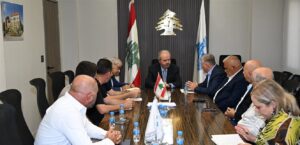
In this context, President Joseph Aoun held a meeting with the President of the Economic and Social Council, Charles Arbid, who handed him a memorandum aimed at addressing the living situation and averting the economic risks to general stability, and included an explicit call for the success of a national economic and social dialogue.
Economic estimates for a family of four renting a house in Beirut or its suburbs indicate that the cost of housing, food, electricity, water, and transportation alone ranges between $1,400 and $1,500 per month. In contrast, International Labor Organization data indicate that the average worker’s income in Lebanon does not exceed $560 per month.
Even if there are two workers in the family who together earn $1,120, the total income fails to cover the minimum basic requirements. These accounts do not include other main sections such as education, hospitalization, medicines, clothing, communications, or emergency expenses, in addition to families being forced to shorten the food basket and exclude meat and cheese. This is offset by the Authority continuing to impose additional taxes to finance its plans.
Mathematical models, whether calculating the cost of gasoline or using public transportation (services and vans), show that the five basic needs range between $1,403 and $1,486 per month. These items represent between 250.5% and 265.4% of the average income of an individual worker, while leaving a monthly deficit ranging between 283 and 366 dollars for families that include two workers.
This reality comes as a continuation of a long path of inflation. Since the summer of 2023, prices have increased by a cumulative rate of 77.3%, which means that what was previously purchased for $1,000 now requires about $1,770 today. For example, the price of a can of gasoline rose from 25,000 liras in 2019 to about 2.8 million liras currently, while the price of a loaf of bread rose from 1,500 liras to 100,000 liras in conjunction with a decrease in its weight, amid repeated warnings of a “social explosion,” the repercussions of which will be postponed at each station due to official calming policies.
On the other hand, the European Commission announced the provision of financial support to Lebanon worth 505 million euros for the years 2026 and 2027, representing the second part of the one billion euro package announced by Commission President Ursula von der Leyen during her visit to Beirut in May 2024. The new funding will be allocated to support major reforms, recover the economy, enhance security and border management, maintain basic services for the most vulnerable groups, and help Lebanon confront the repercussions of instability and displacement in the region.