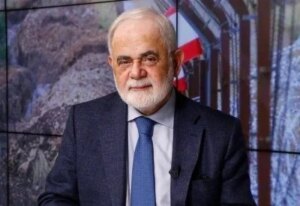
The head of the executive body of the Amal Movement, Mustafa Al-Fouani, stressed that Lebanon cannot be managed with the logic of dominance or elimination, stressing that dialogue, national partnership, and adherence to the elements of power constitute, in the movement’s opinion, basic pillars for protecting the country in the face of internal and external challenges.
Al-Fouani said, during a symposium held within the activities of Imam al-Sadr Month on the 48th anniversary, that the national project carried by Imam Musa al-Sadr was based on building a just and strong state that protects all its people, preserves their dignity, and preserves the land, sovereignty, and wealth.
He stressed that “Lebanon is a final homeland for all its people,” considering that there is no place in it for the logic of abolition, dominance, or turning sectarian diversity into a project of division, and that protecting the country is not achieved by the victory of one political party over another, but rather by presenting the national interest over factional accounts.
Al-Fouani believed that dialogue in Lebanon is not a political luxury, but rather a national necessity that prevents differences from turning into clashes, and protects civil peace from division and fragmentation projects.
He said that this approach constitutes one of the constants held by Parliament Speaker Nabih Berri, considering that “Lebanon can only be managed in partnership, protected only through unity, and its crises can only be resolved through dialogue.”
He added that the Lebanese may differ in political positions and choices, but they do not have “the luxury of abandoning the homeland,” warning that political disagreement could turn into a demolition of state institutions, a threat to civil peace, or a gateway to serving foreign projects.
Regarding Israel, Al-Fouani considered that it still poses a threat to Lebanon’s sovereignty and future, stressing that the state and the people have the right to protect the land and adhere to what he described as “elements of force” that prevent aggression and protect sovereignty.
He stressed that “defending the homeland is not a call to war, but rather a refusal to surrender,” considering that countries that lose the ability to protect themselves become vulnerable to pressure, aggression, and guardianship.
In this context, he stressed that “resistance” for the “Amal” movement represents a right to defend land, people, and dignity, and is part of Lebanon’s history in confronting Israel, noting that the concept proposed by Imam Musa al-Sadr was, according to him, resistance for the sake of Lebanon, its sovereignty, and its independence.
Al-Fouani also recalled Imam al-Sadr’s saying that “Lebanon’s peace is the best form of war with the enemy,” considering that fortifying the interior and the unity of the Lebanese constitute the first line of defense, because Israel, according to his position, is betting on internal divisions as much as it is betting on its military superiority.
Regarding the Palestinian file, Al-Fouani stressed the Amal Movement’s adherence to the Palestinian issue, considering it to be an issue of justice and a people’s right to their land and dignity, and not a separate issue from national and humanitarian issues in the region.
He focused on Berri’s role in carrying the political legacy of Imam al-Sadr, considering that he adhered to dialogue in the most difficult stages, to unity in times of divisions, and to Lebanon’s rights against Israel, and that this path is not presented as a legacy of the past, but rather as a continuing political option for the future.
Al-Fouani concluded by emphasizing that the Lebanon that Imam al-Sadr wanted was a state in which one team does not defeat another, but rather a strong and just state based on partnership, unity and dialogue, that preserves sovereignty and places the human being and his dignity at the heart of its national project.