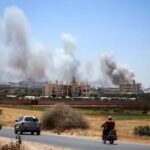
12 Arab and Islamic countries escalated their stance towards the Israeli operations in Syria, as the foreign ministers of Qatar, Jordan, Algeria, Indonesia, Lebanon, Malaysia, Mauritania, Pakistan, Palestine, Saudi Arabia, Somalia and Turkey strongly condemned the Israeli air strikes that targeted the Abu al-Duhur military airport in northwestern Syria, considering them to constitute a “dangerous escalation” and a violation of the country’s sovereignty and territorial integrity.
A joint statement issued in Doha, today, Friday, August 21, 2026, said that the ministers condemned the Israeli raids on the airport, stressing that the attacks represent “a flagrant violation of the sovereignty, security, stability and territorial integrity of the Syrian Arab Republic.”
The ministers expressed their deep concern about the continued targeting of Syrian territory and its infrastructure, warning that the repetition of these operations may undermine the efforts made by Damascus to restore security, rebuild state institutions, and address the humanitarian and economic repercussions resulting from long years of war.
The statement stressed that Israel’s continuation of its operations inside Syrian territory carries the risk of increasing the level of regional tension, threatens the chances of achieving stability, and also leads, according to the ministers, to a decline in respect for the rules of international law and the principles of the United Nations Charter related to the sovereignty and territorial integrity of states.
The foreign ministers called on the international community to take a “firm, clear and principled position” towards the Israeli operations in Syria, calling for taking concrete steps in accordance with international law and the United Nations Charter to put an end to violations and prevent further escalation.
The statement also brought back to the forefront the disengagement agreement signed between Syria and Israel in 1974, as the ministers demanded that it be fully respected, in addition to the withdrawal of Israeli forces from the Syrian areas they had entered, stressing that preserving Syria’s sovereignty and territorial integrity constitutes an essential element to prevent the expansion of tension in the region.
The ministers concluded by emphasizing the need to respect Syria’s sovereignty, security, stability and territorial integrity, and to reject any attempt to undermine them.
The collective stance comes after the raids that targeted the Abu al-Duhur military airport in the eastern countryside of Idlib at dawn on August 18, when the Syrian authorities spoke of carrying out 8 raids on the airport, which had been out of service for years, and caused material damage without announcing any casualties.
The targeting of Abu Al-Duhur brought the airport back to the forefront of regional tension, after his name was recently linked to reports about Turkish interest in the site and its possible use within the framework of military cooperation between Ankara and Damascus.
The office of Israeli Prime Minister Benjamin Netanyahu had justified the strike by talking about the possible deployment of Turkish forces at the airport, considering that a Turkish military presence there could pose a threat to Israel, while Turkey and Syria denied the existence of a plan for a Turkish military deployment in Abu al-Duhur in the manner described by Israel.
Ankara stressed, on the other hand, that its cooperation with Damascus aims to support Syria’s stability, build the capabilities of its institutions, and preserve its territorial integrity, while Syrian Foreign Minister Asaad Al-Shaibani stressed that Turkey is an essential partner for Syria, and that Israel has no right to dictate to Damascus the nature of its alliances or regional relations.
The targeting of the airport sparked criticism that was not limited to Damascus and Ankara, as Washington described the raids as an “unnecessary escalation,” in conjunction with American communications aimed at preventing the growing tension between Israel and Turkey in the Syrian arena from turning into a direct confrontation.
The strike acquires special sensitivity in light of the significant expansion in relations between the Syrian government headed by Ahmed al-Sharaa and Turkey, which has become one of Damascus’s most prominent regional partners in the security, military, economic, and reconstruction files.
On the other hand, Israel views with caution the possibility of expanding the Turkish military presence inside Syria, especially the deployment of air defense systems, drones, or the use of Syrian military bases, which has made this file one of the most prominent sources of friction between Ankara and Tel Aviv.
The raids on Abu al-Duhur also come within a broader context of Israeli operations in Syrian territory, which during the past period included military sites and areas in the south, in parallel with repeated incursions into Quneitra Governorate, raids, arrests, and the establishment of military points, checkpoints, and movements near the line of separation of forces.
The sensitivity of the southern Syrian file has increased since the fall of Bashar al-Assad’s regime in December 2024, when Israeli forces expanded their deployment in the buffer zone and other locations inside Syrian territory, amid the objection of Damascus, which is demanding withdrawal and a return to the arrangements of the 1974 disengagement agreement.
The aforementioned agreement stipulates the separation of Syrian and Israeli forces and the establishment of a separation zone supervised by the United Nations Disengagement Observer Force (UNDOF), and for decades it has been the basic framework for organizing the military situation on the Golan front.
Therefore, the latest joint statement is not limited to condemning a single raid, but rather links the targeting of Abu al-Duhur to the entire Israeli presence and movements inside Syria, and demands a return to the rules of the 1974 agreement and the withdrawal of Israeli forces from the areas they entered.
The joining of Lebanon, Saudi Arabia, Qatar, Jordan, Turkey, Pakistan and other countries to a unified position carries an additional political significance, as it reflects the widening of regional objection to the continuation of Israeli operations inside Syria, especially at a stage when Damascus is trying to rebuild its institutions and expand its Arab and regional relations after years of war.
Thus, the Abu Al-Duhur raids are transformed from a military incident into a regional diplomatic file, with the objection moving from individual statements issued by a number of capitals to a joint position of 12 countries calling on the international community to take action, and adhering to Syria’s sovereignty and territorial integrity and the necessity of returning to the disengagement agreement and preventing the region from sliding into a new round of escalation.