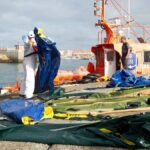
The Spanish police dismantled two networks specialized in smuggling irregular migrants by sea from Ceuta to the Spanish mainland, and arrested 5 people who, according to investigations, were exploiting the recent migration crisis to organize secret trips through the Strait of Gibraltar in exchange for sums of up to 9 thousand euros per person, using small boats and under conditions that threaten the lives of the passengers.
The Spanish National Police announced that the two operations were carried out in Ceuta and the city of La Linea de la Concepcion in the Cádiz province, and resulted in the discovery of an integrated mechanism for transporting migrants who entered Ceuta irregularly, before being smuggled by sea to the Spanish peninsula.
In the first operation, the police arrested 4 people, two in Ceuta and two in La Linea de la Concepción, on suspicion of belonging to a criminal organization and facilitating irregular migration. The network used small boats departing from the Spanish coast towards Ceuta, then returning loaded with migrants to the Andalusian coast.
According to the investigation, members of the network were relying on intermediaries to attract migrants wishing to move from Ceuta to the Spanish mainland, and they were asking each person for about 9,000 euros for the trip.
Before departure, migrants were hidden in homes, garages, and temporary places, and then cars were used to transport them secretly to meeting points with boats far from security observation sites.
The smugglers also selected boat drivers based on their experience in fast sailing and their ability to execute maneuvers at sea in order to evade patrols and control points, on a journey that passes through one of the busiest and most sensitive sea lanes between Africa and Europe.
The threads in this case began after a speedboat was found stuck on a rocky area near Benzo in Ceuta. According to police, the examination showed signs and damage consistent with its use for high-speed navigation, prompting investigators to trace the network suspected of being preparing to use it to transport migrants to the Spanish coast.
As for the second investigation, it led to the arrest of a fifth person who was placed in pretrial detention, after he was accused of participating in the operation to transport 7 migrants by sea on the night of August 14.
According to investigations, each of these people paid about 8,000 euros, and they were placed inside a boat no more than 5 meters long and without the minimum safety equipment or life jackets, before the journey took about 5 hours in the middle of darkness and fog.
The boat arrived at the vicinity of El Burgo Beach near La Linea de la Concepcion at dawn, after traveling dozens of kilometers through the strait in conditions that the authorities described as extremely dangerous to the lives of the passengers.
The Spanish police have not yet revealed the total number of people the two networks were able to smuggle during their period of activity, while investigations are continuing to determine the extent of their operations and other people who may have participated in organizing, financing, or providing transportation and shelter.
The operation comes at a very sensitive time for Ceuta, which last July 30 witnessed an unprecedented mass crossing, after more than 70,000 people entered there irregularly within a short period, most of them across the border or sea, in a crisis that put the city’s security and humanitarian capabilities under exceptional pressure.
The crossing wave was accompanied by dozens of casualties, while thousands of migrants remained inside the city after large numbers of them were returned, which created an environment that smuggling networks exploited to provide what they described as a faster route to the Spanish mainland in exchange for exorbitant sums of money.
On August 5, the police announced that they were able to identify 528 minors who entered Ceuta during the mass crossing wave and are still there, while other minors remained in the streets and near industrial areas waiting for shelters to be secured for them.
Ceuta is located on the northern coast of Africa and is subject to Spanish administration, which makes it, along with Melilla, one of the most prominent pressure points on the external borders of the European Union, as migrants try to reach it via Morocco in the hope of later moving to the European mainland.
The Strait of Gibraltar separates Ceuta and its surrounding areas from the southern coast of Spain, but the relatively short sea distance does not make the journey safe, as the Strait witnesses heavy ship traffic, strong sea currents, and rapid changes in weather conditions, making small boats vulnerable to sinking or losing control.
Smuggling networks take advantage of this reality by using fast and small boats, some of which are designed to reach the coast and return in a short time, while migrants pay very high sums for the trip, despite the absence of any guarantees for their safety or even their arrival at their destination.
Just two weeks ago, the Spanish authorities had also announced the dismantling of one of the largest migrant smuggling networks in the Mediterranean in a separate operation, which resulted in dozens of arrests and the seizure of 18 speedboats, after documenting at least 64 trips used to transport more than 2,000 migrants, which reflects the expansion of criminal activity linked to maritime migration routes towards Spain.
The latest operation reveals an additional facet of the Ceuta crisis, as the risks do not stop when trying to reach the Spanish enclave, but after that a new underground market begins in which migrants pay thousands of euros to reach the European mainland, on sea trips carried out at night and on small boats and without safety measures, while smuggling networks reap huge profits from exploiting desperation and the desire to reach Europe.