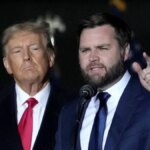
On Friday, US President Donald Trump and his Vice President, J.D. Vance, are moving on two parallel internal fronts, the first is electoral in South Carolina to support a Republican candidate running in a decisive race for the Senate seat, and the second is economic in Ohio, at a time when the administration is facing increasing pressure due to public debt and bond markets, in parallel with open judicial and foreign files.
Trump is heading to South Carolina to participate in an election rally in support of Republican Senator Darlene Graham, before the runoff in the Republican primary elections scheduled for August 25, in which he faces Representative Ralph Norman.
Graham is not an ordinary candidate in the race, as South Carolina Governor Henry McMaster appointed her last July 13 to fill the seat that became vacant after the death of her brother, prominent Republican Senator Lindsey Graham, on July 11. Thus, she became the first woman to represent the state in the US Senate.
In the special primary elections held on August 11, Graham came first with about 33% of the votes, compared to about 25% for Norman, while no candidate obtained the percentage required to decide the race in the first round, forcing a runoff between them.
Through his personal presence, Trump is trying to give Graham a final political boost before the vote, after he had previously announced his support for her, even though her rival, Norman, is in turn a conservative Republican who supports Trump and belongs to the Freedom Caucus in the House of Representatives.
Graham faces a difficult test due to her lack of political experience, a point that has become a main focus of Norman’s campaign against her, especially after the debate that took place last Tuesday.
During the debate, Graham was asked whether Taiwan and the South China Sea represented a national security issue for the United States, and she admitted that she was not sufficiently informed about the national security file, before confirming her support for the American military. Her answer sparked widespread criticism, especially since her late brother, Lindsey Graham, was known for his strong presence in foreign policy and defense issues.
Trump, who enjoys great electoral weight within the Republican base in South Carolina, is trying to prevent this lapse from becoming a decisive factor in the final round, in a race whose outcome will be an additional indicator of the extent of the president’s ability to impose his choices within the party before the midterm elections.
In parallel with Trump’s electoral move, Vice President J.D. Vance heads to his hometown of Middletown, Ohio, where he delivers an economic speech at a facility affiliated with the “Cleveland Cliffs” company, in a politically symbolic return to the industrial area that has formed an essential part of his political image since he entered public life.
Vance’s speech comes amid mounting concerns about the state of US public finances, after the national debt exceeded the level of $40 trillion for the first time, coinciding with a rise in long-term Treasury bond yields and an increase in the cost of government borrowing.
Vance had defended Treasury Secretary Scott Besent’s plan, considering that the administration had a path that would allow the economy to grow faster than the growth of debt, and holding the administration of former President Joe Biden responsible for a large portion of the financial burdens inherited by the Trump administration.
But markets are still watching this plan cautiously. Besant announced increased repurchases of longer-term Treasuries in an attempt to ease pressures on the debt market and reduce yield disruptions, a move that provided a temporary calm before fears of inflation, deficits and high debt came back to the fore.
The essence of the administration’s economic bet is to accelerate growth, gradually control spending, and attempt to reduce the cost of debt service, but the size of the debt and the exceeding of annual borrowing interest levels have made the issue one of the most prominent challenges facing Trump and his team before the midterm elections.
In parallel with the electoral and economic moves, the administration is still waging a legal battle over the new White House ballroom project, which costs about $400 million.
An appeals court had upheld stopping above-ground construction work on the grounds that the project needed Congressional approval before the Trump administration could resort to the Supreme Court.
In a development that occurred on Friday after the initial data on the file was published, Supreme Court Chief Justice John Roberts temporarily allowed construction work to continue while the court considered the emergency request submitted by the administration, giving Trump a new judicial deadline without constituting a final ruling on the origin of the dispute.
Externally, Trump continues to seek to reopen a direct channel with North Korean leader Kim Jong Un, after he announced his desire to hold a new meeting with him, coinciding with Washington reducing the size of joint military exercises with South Korea.
Trump had ordered a reduction in joint exercises with Seoul, considering them costly and irritating Pyongyang, in a move that raised concern within South Korea about the future of the American security commitment and the nature of the defense relationship between the two countries.
But the North Korean response remained cautious. Despite indications that the good personal relationship between Trump and Kim continues, Pyongyang is demanding a broader change in US policy before returning to serious negotiations, and it recently launched a batch of short-range ballistic missiles in a clear message of pressure.
Thus, Trump and Vance’s day comes within a crowded American landscape: a battle within the Republican Party in South Carolina, economic messages to reassure markets and voters in Ohio, a legal dispute over the White House project, and an attempt to revive Trump’s personal diplomacy with North Korea.