“Libyan Dibit” – Abdullah Waht
The Lebanese scene is more complicated. The government session last Friday, which I want to be an internal title for the breakthrough, increased the darker abroad, after a negative atmosphere reached in Lebanon as a result of what was considered “lack of clarity” in the government’s decision regarding the plan that the army made to restrict weapons.
The first signs were expressed by the visit of Morgan Ortigos, accompanied by the new leader of the American Central Command, Admiral Brad Cooper. Ortagus wanted not to visit any of the politicians, preferring to take security with Lebanon almost independently.
This was previously indicated that the plan that the army submitted to the Council of Ministers, without specifying mechanisms or time to disarm, did not have American approval from the beginning, as it was based on Lebanese amendments that were made to the paper of Tom Barak; These are amendments that were previously rejected by both Americans and Israelis, after they confirmed that they were not concerned with any steps opposite the Lebanese step.
Besides, the changes in the American middle leadership are not consistent with Lebanese hopes. Admiral Cooper, who took over the presidency of the middle leadership, is considered a new generation that has no relations with Lebanese officials, unlike his predecessors. He is also the owner of a prominent field experience as a theorist of American strikes on Yemen and a supervisor, which means that his background is pure military, and his dealings are supposed to be so. The scene increased complicated by President Donald Trump recently to replace the name of the US Department of Defense with the “Ministry of War”, in reference to an American -military strategic transformation towards more direct involvement in the region’s wars.
Lebanon, of course, will not be immune to these changes. One of the prominent indicators is the restructuring of the American envoy in Lebanon, as Tom Brak was displaced to replace it, Morgan Ortigos, with a direct authorization from President Trump, according to what Brak himself announced from Baabda Palace during his recent visit to Lebanon.
This change is accompanied by the appointment of Cooper, who the sources say is closely to Ortugus, which prompted them to share Lebanese roles. For the Americans, for the Americans, it is not only political, but it has turned into a political -military file with security dimensions; Ortigos takes over the path of security negotiation/mobile with Israel, while Cooper – who chose an officer who will call him to head the triple mechanism (Mechanism) to succeed the current general Michael Lenny – direct supervision on the military side. It is hesitant that the proposed officer was a direct assistant to Cooper, and he is also from the US Navy.
Politically, these changes were reflected in the Lebanese interior. The change in the path of the American mission led to more tight control over the official performance, especially after it was understood that the recent cabinet session ruled to freeze the Lebanese decision to move towards the inventory of weapons, and thus the deadline that the government itself set at the August 5 session, which was supposed to end by the end of this year. As a reminder, the commander of the army, General Rudolph Haykal, had linked the resumption of the plan and its inventory in the south of the Litani, to be achieved within three months, and then expanding outside it; It is the three months that Washington requested specifically to end what you call the “Hezbollah weapon problem”.
The new American style, as it seems, is moving towards activating the role of the mechanism in a reverse way that serves the American not Lebanese vision, without this means that the semi -weekly meetings will be resumed. During the past three months, specifically, since Tom Barak received mediation, an atmosphere stated that the Americans had asked the Israelis to neutralize Beirut (including the southern suburb) from any direct shelling. This was subsequently translated in a famous statement of the enemy’s army, in which it hinted that Hezbollah is developing coordinates inside the suburbs. Its day was surprised by his lack of initiative to target it as previously and did, to understand later that Washington requested the freezing of strikes.
Today, it is proposed that the reactivation of the mechanism – according to the American vision – will constitute an entrance to return to the old approach; Any follow -up to the provision of intelligence data to the Lebanese army to raid specific sites outside the southern Litani region – specifically towards the suburb and other regions. In this way, Washington exceeds the decisions of the Lebanese government, and practically imposes the move of the army from southern Litani to the same, with the possibility of the Israeli air force to be used in new bombing operations, whose goal is not only to cause military harm, but to pressure the Lebanese government.
In this context, information about the visit of Admiral Brad Cooper to Beirut, accompanied by Morgan Ortigos, was leaked, while the central leadership announced through its account that Cooper started his tour by visiting Israel. From there, Cooper affirmed Washington’s commitment to “the deep protection of Israel’s security.” After that, the Hebrew media reported that Cooper visited the Gaza cover settlements, as the Israeli government created a mandatory shrine to inspect what it called “the effects of the October 7th attack.” From there, Cooper renewed the confirmation of the US eternal commitment to Israel’s security.
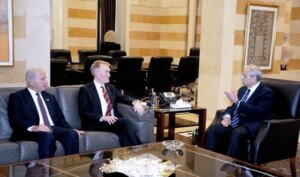
The next day, Cooper arrived in Beirut, where he held meetings during which he stressed the priorities of Washington, the role of the Lebanese army and the need to disarm Hezbollah, and informed – on its sidelines – the changes to be made to the American military vision of Lebanon. But he quickly left for Cyprus, preferring the overnight there awaiting the arrival of Morgan Ortigos, and this has clear indications. The next day, he returned to Beirut, where they participated in the monthly mechanism meeting, then they made a air tour along the South Litani line using a jungle of UNIFIL, not to the Lebanese army, before they left without conducting meetings.
The post The “American army” puts its hand on Lebanon! appeared first on 961 tobay Lebanon today.