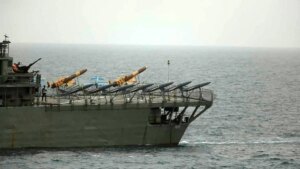
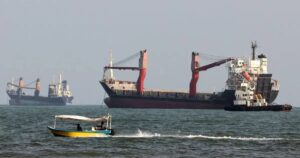
American forces deployed in the Middle East are facing increasing pressure as a result of the continuation of intense air and naval operations, with the aim of securing navigation in the Strait of Hormuz and protecting commercial ships from attacks, in conjunction with the imposition of a blockade on Iranian ports. This escalation raises serious concerns that the long duration of operations will affect the readiness of the US Army and its ability to deal with urgent international crises.
According to a report by the Wall Street Journal, the continuous operations, which are carried out from two aircraft carriers, an amphibious landing ship, and regional air bases, impose heavy burdens on the aircraft, their crews, maintenance teams, and mechanics who work around the clock to maintain the readiness of the equipment.
In this context, the forces intensified their nightly air sorties over the Strait of Hormuz to monitor the airspace and immediately intercept any projectiles that might target commercial ships, basing their assessments on the testimonies of pilots and crew members of the aircraft carrier USS George Washington.
The danger of the mission increases due to the narrow airspace over the strait, which does not exceed 20 miles in width, and the density of flying objects in it, which reduces the time available for pilots to monitor and deal with threats coming from the Iranian coast.
Rear Admiral Jeffrey Himes, commander of the George Washington aircraft carrier group, explained that American aircraft intervene to intercept threats directed at ships, whether they are anti-ship cruise missiles or drones, stressing that the interceptions are carried out in record time.
In terms of results, US Central Command (Centcom) reported that maritime protection enabled Washington’s partners in the Gulf to export more than 1.5 billion barrels of crude oil since last summer, while more than 3,000 commercial ships crossed the Strait of Hormuz during the past six months without incident. On the other hand, the Commander of the US Central Command, Admiral Brad Cooper, confirmed Iran’s inability to export any oil since the blockade was imposed on its ports.
However, this intense pace caused accelerated wear and tear on aircraft as a result of increased flying hours, and increased the pressure on technical crews. The newspaper quoted informed American officials as saying that repeated flights exhaust equipment and personnel. Adi Schaefer, an officer in the aircraft maintenance department aboard the George Washington, pointed out that increasing flight hours increases the possibility of the fighters being damaged and requiring frequent maintenance.
The challenges are not limited to aviation, but extend to marine vessels. Admiral Darrell Caudle, Chief of US Naval Operations, said that the Navy is taking these pressures into account, pointing to the establishment of a ship maintenance center at the Diego Garcia base in the Indian Ocean, and the increase in stopping times for ships at ports. In an indication of the extent of the burden, the crew of the aircraft carrier USS Abraham Lincoln spent 286 days at sea, in a period of deployment that was described as record.
Financially, the cost of the American military presence is divided between ammunition, fuel, equipment maintenance, and logistical and operational expenses. The United States currently deploys about 50,000 soldiers and 20 warships in the region, and the cost of maintaining this presence ranges between two and three billion dollars per month.
In light of these facts, warnings are mounting that the continuation of intensive operations will lead to the depletion of the US Army’s resources, which may limit Washington’s ability to respond to developments and crises in other regions around the world.