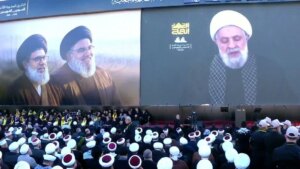
The Secretary-General of Hezbollah, Sheikh Naim Qassem, raised the ceiling of his political and field positions, stressing my party’s refusal to give up any inch of Lebanese territory, and adhering to the option of resistance, during his speech on the second anniversary of the assassination of Messrs. Hassan Nasrallah and Hashem Safi al-Din.
Qassem stressed that “whoever bets that he will have a part of Lebanon in exchange for giving up the other part of the land or the people is delusional,” considering that “the foundation of the country, the pillar of the country, and the future of the country is southern Lebanon,” stressing his refusal to give up a single inch of the country’s area of 10,452 square kilometers, because “surrender to the Israeli enemy means the end of Lebanon and coexistence in favor of the Israeli settlements.”
Regarding the military file, Qassem touched on the role of the Lebanese Army, describing it as the “National Army,” and warning against attempts to make it a tool in the hands of other parties, saying: “Asking the Lebanese Army to be a tool for you, this is a burden on your neck.” He added: “You spent two years trying to disarm, but you were unable, so why do you ask the Lebanese army? What is your relationship with weapons?”, pointing out that the memorandum of understanding was what reduced the level of escalation to its current level.
He sent a message to those he described as “sovereigns,” asking: “We are not told: Look what the aggression did because you are resisting it, but rather: Why do you not resist it yourself? And why do you give in?” Pointing out that “resistance only arose because of aggression,” and that “aggression is the cause and problem,” not resistance.
Regarding the field situation, Qasim revealed that everyone was surprised by the preparations for the “Battle of the All-consuming Storm,” explaining that the concealment of some details is related to the way and nature of the battle’s management. He pointed out that the resistance depends on two basic things: confrontation in place and time to the extent possible, and preventing Israel from stabilizing.
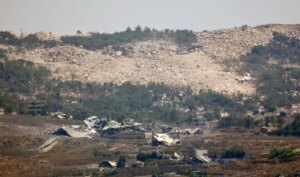
Qassem reviewed the stations of field steadfastness, pointing to the steadfastness in the areas of Ali Al-Taher, Bint Jbeil, Al-Khiam, Aita Al-Shaab, Al-Naqoura, and Al-Bayyada, pointing out by saying: “We faced in many areas and we remained steadfast as resistors and resistance as much as the field and the method of resistance allowed.”