Military operations in southern Lebanon are entering a delicate and extremely sensitive phase, coinciding with a remarkable and proactive Israeli escalation that reflects a trend towards what Tel Aviv calls a “new phase” of operations. The last hours witnessed an intense return to the use of attack helicopters and tanks, in addition to air strikes, artillery shelling, bombing operations, and ground incursions, which opens the door to questions as to whether this escalation is merely a tool to raise military pressure or a prelude to a radical change in the nature of operations and the Israeli presence in the south.
On the diplomatic track, a new date has not yet been set for the Lebanese-Israeli negotiation session, at a time when informed sources of Asharq Al-Awsat newspaper suggest that the head of the Lebanese negotiating delegation, former ambassador Simon Karam, will head to the Vatican. Karam is scheduled to meet with the Secretary of State, Cardinal Pietro Parolin, and the Minister of Foreign Affairs, Paul Richard Gallagher, to discuss the file of negotiations and ways for the Vatican to support this path, in continuation of the efforts raised by the President of the Republic, Joseph Aoun, during his recent visit to Rome.
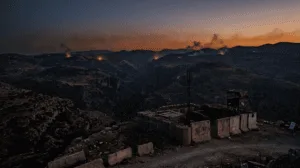
On the ground, Israel escalated its attacks. The Merkava helicopter launched four shells on the town of Hadada before the Israeli forces advanced towards one of the centers and set it on fire, while the Israeli army blew up a number of homes in the town of Mansouri at dawn on Sunday. An Apache helicopter targeted a commercial center on the Shokin-Mifdoun Road, causing severe damage to shops and residential apartments. An ambulance team survived a raid that targeted the same building while conducting a field inspection. For its part, the Israeli army announced that it was attacking Hezbollah targets in response to the launch of a bomb-laden drone towards its forces.
This escalation was preceded by a series of air strikes shortly after midnight on Saturday – Sunday, targeting Nabatiyeh Al-Fawqa and the outskirts of Kafr Tibnit and Mifdoun, where a house was completely destroyed, coinciding with artillery shelling that targeted Doha Kafr Rumman, Wadi Zebqin, the outskirts of Mazraat Al-Shomriya and Al-Qusayr, in addition to sweeping operations with heavy machine guns towards Beit Yahoun, Sarbin, and Wadi Zebqin. Saturday also witnessed artillery shelling on Wadi Al-Saluki, the vicinity of Shaqra, and the eastern outskirts of Zawtar, and violent raids with concussion missiles on Al-Jabal Al-Rafi’i, Al-Rayhan, and the outskirts of Sajd.
In a reading of the field situation, retired Brigadier General and military expert Hassan Jouni explained to Asharq Al-Awsat that the recent operations may represent an extension of the phase related to the Al-Mansouri area, pointing out that there are indications that speak of an Israeli repositioning in fixed locations that are being prepared to stabilize the military and defensive presence in the buffer zone and on the borders of the “yellow line.”
On the other hand, Johnny pointed out that the increasing military focus on Jabal al-Rayhan and its surroundings, Jabal Safi and Sajjad raises fears of the start of possible military action in the Iqlim al-Tuffah area north of Ali al-Tahir, given that it is historically considered one of the last strongholds that includes logistical bases for Hezbollah. Johnny concluded that the possibilities are still open between expanding operations towards Iqlim al-Tuffah or simply installing defensive positions, awaiting what field trends will be revealed in the coming days.