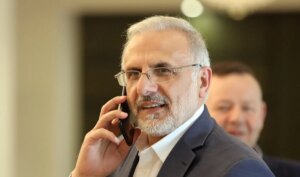
Secretary of the “Democratic Gathering”, MP Hadi Abu Al-Hassan, affirmed the steadfastness of the bloc’s position towards the framework agreement, stressing the necessity of standing by the state in the negotiation process, provided that the decision is national, sovereign and adheres to constants, and leads to ending the occupation, implementing international resolutions and reconstruction.
Abu Al-Hassan criticized the slide of the discussion towards field details and “experimental areas” while ignoring the major headlines, warning that this weakens Lebanon’s legal position and deprives it of its rights. He pointed out that Presidents Joseph Aoun and Nawaf Salam began to notice obstacles and intractability in the negotiations, which is consistent with the vision of former Progressive Socialist Party head Walid Jumblatt.
He considered that Israel was intent on destroying the villages of the south and displacing their people to pave the way for its expansion project, pointing out that the decision on the two support wars – the danger of which the “Democratic Gathering” previously warned of – gave Israel the pretext to invade and prepare for settlement. He recalled historical milestones, pointing out the failure of the Zionist attempts from 1936 until 1982 to bring the Druze and Christians into conflict, leading to the Taif Agreement, which established the identity of Lebanon.
Abu Al-Hassan addressed Hezbollah by saying that the last two wars allowed the Israeli occupation of part of the south with an unprecedented level of destruction and displacement, stressing that internal unity and solidarity are the most powerful weapons in the face of attacks. He explained that the “Democratic Gathering” adopts a single public and direct discourse that Hezbollah recognizes and appreciates.
He reiterated the need to extend the army’s authority, starting from the south of the Litani, expressing his hope for a return to the November 27, 2024 agreement based on Resolution 1701 and the Taif Agreement. He pointed out that the agreement was not implemented due to the absence of American pressure on Israel, and as a result of Iran considering the party’s weapons a valuable card, in addition to the party’s lack of commitment to implementation under the pretext of continuing the occupation.
Abu Al-Hassan warned against the consequences of involving the Lebanese army or putting the state in a confrontation with any Lebanese faction, as this represents a direct threat to civil peace and the cohesion of the military institution, considering that the solution lies in a central and strategic Iranian-American decision to confine weapons to the state in conjunction with a complete Israeli withdrawal.
Regarding government and financial matters, Abu Al-Hassan praised the government’s role in managing public facilities and preparing the budget, stressing that the Parliament will discuss the budget upon its arrival to introduce amendments that serve the interests of citizens and guarantee their rights.