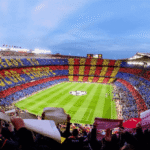
Members of the Spanish club Barcelona approved an additional financing package worth 510 million euros, at a meeting held on September 19, to cover the escalating costs of the Camp Nou stadium renovation project. The allocation of 300 million euros to complete the construction work was approved by 89% of voters, while the remaining 210 million euros – which will be raised through the issuance of bonds to secure the necessary liquidity – received the approval of 85%, in order to meet the delay in revenues expected from the stadium.
The club attributes the additional cost to the expansion of the workshop’s scope of work compared to the original plans. The second runway, whose roots go back to 1957, required more than 3,000 reinforcement operations, compared to about 800 operations that were expected, in addition to adding new VIP spaces and expanding the museum. This situation, in addition to the costs of temporary accommodation at the “Montjuïc” stadium (about 17 million euros in operating costs over two seasons and 24 million in additional investments), led to an increase in the total financing of the “Espay Barsa” project to develop the stadium from 1.5 billion to 1.8 billion euros, bringing the club’s total financial debt to 2.68 billion euros.
In the context of securing liquidity, Barcelona relied again on selling the stadium’s income before its completion. At the beginning of 2025, the club sold to two investment funds the right to exploit 475 VIP seats for a period of 30 years for about 100 million euros. While the new bonds were guaranteed by revenues from television broadcasts of the Spanish League and European competitions, with terms extending up to ten years and a fixed interest. Spanish press reports indicate that the first tranche of the new stadium’s revenues (about 125 million euros annually) will go directly to pay the interest of financiers before any amounts reach the club’s treasury, which has also committed to a condition requiring that 75% of the VIP seats and private cabins be operated by March 2027.
The Catalan club is betting on raising the stadium’s annual revenues to about 450 million euros when it is fully operational, compared to about 200 million euros before the renovation. According to the announced schedule, the stadium is expected to accommodate 95,000 spectators in early 2028, with its final capacity reaching 104,600 seats in the 2028-2029 season, which is the year in which the European Union chose the stadium in mid-September to host the Champions League final.
However, the club faces pressing financial tests before reaching those dates; Each month of delay translates into less income and greater accrual of interest. If the stadium fails to generate revenues as quickly as desired, the financing of 510 million euros may not be the last loan that Barcelona requests to save its largest financial project.