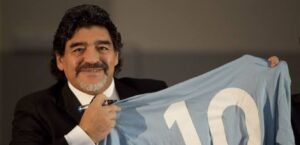
Nearly six years after the passing of Argentine football legend Diego Maradona, a new, unprecedented hypothesis has emerged before the judiciary, which is that the Corona virus may have played a role in his death. This surprising question was posed by the official medical expert, Pablo Ferrari, the last witness in the trial of seven members of the medical team that supervised Maradona, stressing that infection with Covid-19 could not be ruled out as a possible cause of death.
Ferrari explained before the Criminal Court in San Isidro, north of Buenos Aires, that not conducting a test to detect the virus during the autopsy of Maradona’s body was considered a “systematic error,” especially since his death occurred at the height of the pandemic. Although the certificate does not prove that Maradona was infected with the virus, it raises a hypothesis that cannot be confirmed or denied due to the absence of a timely test. The expert indicated, according to Efe, that Covid-19 may develop rapidly and lead to death within hours, pointing out that the available evidence did not allow identifying the exact factor that led to the cardiorespiratory arrest.
In his reading of the last hours of the Argentine point’s life, Ferrari contradicted the estimates of other experts who spoke of a critical condition that lasted about 12 hours, a point that the prosecution relied on to prove the medical team’s negligence. Instead, Ferrari asserted that Maradona suffered a heart disorder and a severe accumulation of fluid in the lungs that led to his suffocation and his heart stopping in a period that lasted from a few minutes to a few hours, a proposition that is in the interest of the defense that aims to prove that the death was sudden. Ferrari is the only official expert to support this hypothesis in court.
It is noteworthy that Maradona died on November 25, 2020, at the age of 60, while receiving care in a house on the outskirts of Buenos Aires following surgery to remove a blood clot in the brain. Seven members of his medical team are being tried in the case, including neurosurgeon Leopoldo Luque, psychiatrist Agostina Kosachov, and doctors and nurses, amid collective denial of violations. While the prosecution believes that home care lacked equipment and follow-up, the defense insists on the suddenness of the death and its connection to the deceased’s health problems, waiting for the next session to be held on September 29 to complete the defendants’ statements before the closing arguments begin on October 8.