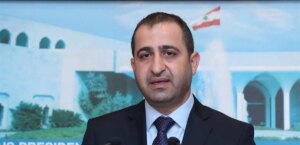
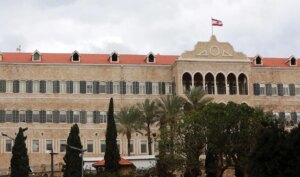
Today, Saturday, the Minister of Justice, Adel Nassar, conducted a field visit to the Nabatieh Palace of Justice, to see its readiness and discuss ways to revive judicial work there, after its departments stopped since the start of the Israeli aggression last March, which forced judges and employees to conduct business from the capital, Beirut.
The delegation accompanying Minister Nassar included the first president of the Nabatieh Courts of Appeal, Judge Munif Barakat, and the media advisor to the minister, Youmna Fawaz. Upon their arrival, they were received by the Public Prosecutor of Appeal in Nabatieh, Judge Najat Abu Shakra, First Investigating Judge Kamal Miqdad, Investigating Judge Fatima Majed, Mayor of Nabatieh Abbas Fakhreddine, Mayor of Kafr Rumman Abdullah Farhat, along with a crowd of officers and employees.
The Minister began his visit with a field tour that included the corridors and halls of the Palace of Justice, followed by an expanded meeting in the office of Judge Abu Chakra, during which the steps leading to reopening the building to lawyers and citizens and resuming sessions and judicial work were discussed.
In a related context, the mayor of Nabatieh, Abbas Fakhr El-Din, considered that the return of state institutions to the city constitutes an essential foundation for enhancing citizens’ sense of security and stability. He pointed out that a number of security agencies and official departments have returned to work in the city, expressing his hope that work at the Palace of Justice will soon resume to ease the burden of transportation on citizens and facilitate the handling of their cases.
For his part, the Minister of Justice stressed the Ministry’s great interest in the return of the judicial wheel to Nabatieh, explaining that his visit aims to support the judicial body and evaluate alternatives, whether by expanding the scope of work in the new center in Beirut or gradually returning to the main headquarters in Nabatieh.
Nassar explained that making the final decision requires careful study of several criteria, most notably the integrity of the files, the readiness of judicial assistants, the adequacy of reporting mechanisms, and the regularity of the work of the authorities associated with judicial affairs, stressing that the ultimate goal remains finding the optimal solution to serve the people of Nabatieh Governorate and the southern region in general.
Nassar added: “Our duty is to be in Nabatieh today, and the state has one concern, which is its children, and there are no other projects, and its project is one: the state everywhere, because it is in the service of all citizens,” stressing that “our choice is the state.” He pledged that the Ministry would repair the material damage caused to the Palace of Justice as a result of the Israeli attacks, and ensure the continuity of judicial services despite the gravity of the challenges.
In turn, Judge Munif Barakat expressed his appreciation for the visit of the Minister of Justice and his keenness to support the judges, reviewing the extent of the difficulties that the judges and judicial assistants faced over the past six or seven months while working in the new department in Beirut, where a number of them were forced to work within one office, in addition to the complexities of transferring files from Nabatieh and its courts in Hasbaya, Tibnine, Marjayoun, and Bint Jbeil.
Barakat also praised the vital role played by the municipalities of Nabatieh and Kafr Rumman in repairing faults, limiting damage, and preserving file archives, as well as the efforts of the security services in protecting the Palace of Justice despite the repeated bombing and raids, concluding by saying: “Our duty is to serve the people and return to Nabatieh,” while anticipating that the appropriate decision will be taken in coordination with the Minister of Justice and the judicial body.
The Minister of Justice concluded his tour in Nabatieh by inspecting the city’s commercial market, which was subjected to widespread destruction as a result of the aggression.