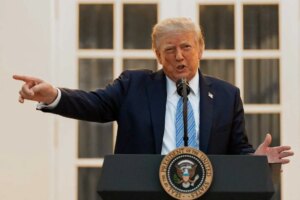
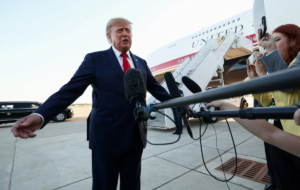
Citizens in Denmark and Greenland reacted positively, on Saturday, to US President Donald Trump’s announcement that an agreement had been reached on the island, amid estimates by Danish commentators that Copenhagen had achieved a diplomatic gain, despite Trump’s assertion that the agreement gives the United States “permanent control” over the island’s security.
In this context, Orla Juulsen, an activist supporting Greenland’s sovereignty, considered, via the “X” platform, that the agreement represents a victory over Trump’s efforts to annex the island, stressing that it enshrines the sovereignty of the Kingdom of Denmark, its territorial integrity, and the right of the people of Greenland to self-determination. In Denmark, citizens expressed their relief at the approaching turning of the page on the crisis, as Michael Burgard expressed his hope that it would end, and teacher Michael Friis described the agreement as “the most realistic solution.”
For its part, the Danish government expressed cautious optimism about the agreement, which aims to strengthen the American military presence while keeping Greenland under Danish sovereignty, following months of Trump’s statements demanding control of the island. Trump explained that the agreement gives Washington “permanent control” over security and other needs, indicating that his administration will immediately begin expanding its military presence. On the other hand, Danish Foreign Minister Lars Løkke Rasmussen stressed that the understanding serves the security of the Arctic, the North Atlantic, NATO, and Europe, while respecting Denmark’s “red lines.”
In turn, Greenland’s Prime Minister Jens Fredrik Nielsen welcomed the agreement, considering that it supports collective security and sustainable development, while its Foreign Minister Moti B. Aygede indicated that concluding the agreement was “within reach.” The understanding was also welcomed by Admiral Giuseppe Caffo Dragoni, Chairman of the NATO Military Committee.
It is expected that the three governments will sign the agreement next week on the sidelines of the United Nations General Assembly meetings, and its approval will later be presented to the parliaments of Denmark and Greenland.
In their reading of the scene, Danish commentators saw that Copenhagen emerged from the crisis without significant losses. Jakob Heinle Jensen wrote in the Berlin newspaper that Denmark is the victorious party, pointing to the success of Danish officials in marketing the agreement to Trump as a personal achievement for him. Analysts pointed out that Washington already had the ability to strengthen its military presence on the island based on a defense agreement dating back to 1951 and updated in 2004.
In the same context, researcher Mark Jacobsen believed that the understanding achieves the interests of the three parties. It allows Trump to appear victorious, especially in light of his preoccupation with the war with Iran and the trade war with Canada, and avoids him opening a new conflict front with Greenland and the European Union. He added that the proposal to annex the island has become practically excluded, recalling that during the Cold War the United States deployed about 25,000 soldiers in 17 bases there, which confirms that expanding the military presence was already possible.
For his part, Trump stressed that the agreement would prevent China and Russia from establishing military bases in Greenland, while Jakobsen pointed out that Denmark had prevented a Chinese company in 2016 from acquiring a former military base on the island.
This agreement culminates months of tension between Washington and Copenhagen over the future of Greenland and its strategic role, following Trump’s repeated emphasis since his return to the White House last January on Washington’s need for the island for security reasons, which raised European concern and Danish tension, concluding with a negotiating path that strengthened the American presence without compromising Danish sovereignty, according to Copenhagen’s assurances.