Writer and political analyst Ibrahim Bayram, in a reading of the Lebanese political scene on the “Lebanon Debate” website, confirmed that talk about “Hezbollah” seeking to overthrow the current government is inaccurate, explaining that the party sees it as a “political umbrella” and a cover it needs at the current stage to avoid restructuring from scratch. He pointed out that the relationship between the party and Prime Minister Nawaf Salam has turned to transparency and rationality after the latter retreated from his initial enthusiasm in confronting the party, noting that the role of the Prime Minister has become secondary in this file, with the task of confronting the party being transferred to the President of the Republic, thanks to an Arab and Saudi desire that prefers Salam to retreat to the back ranks.
Regarding external developments and negotiations, Bayram attributed the marginalization of the role of Foreign Minister Youssef Raji to his exceeding the required ceiling in confronting Hezbollah, which left him with the choice of aligning with the vision of the President of the Republic or exclusion. Bayram revealed that consultations had previously taken place between Parliament Speaker Nabih Berri and Prime Minister Nawaf Salam to conduct a government amendment that would calm internal tension and satisfy the party, before settling on the continuation of the current government due to the lack of guarantees for the formation of an alternative, which made its survival a categorical interest for the various forces, including the party and Berri.
On the broader political level, Bayram suggested that Lebanon is heading towards an equation similar to “the status of the West Bank,” based on “forced coexistence” between an official authority that is moving towards negotiation and ending the state of hostility with Israel under presidential auspices, and Hezbollah, which clings to its weapons and its own approach to confrontation, with each party playing its role under one roof imposed by circumstances and not a voluntary choice.
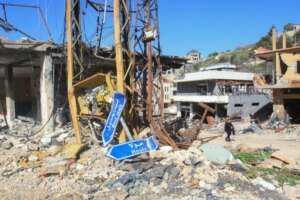
Regarding future bets to weaken the party, the political analyst pointed out that some local and international forces are betting on exploiting American and Israeli pressure to target the party’s incubating environment without a direct clash. He explained that the Israeli actions in the south, which include the destruction of villages, the policy of “gradual annexation” of lands, and the prevention of the return of about 400,000 displaced persons, aim to bring about a field and demographic change that is being relied upon to bring about a gradual shift in the position of the environment supporting the party, stressing that this path requires a long time.
Bayram concluded his reading by emphasizing that the field data refute the bets of Washington, Tel Aviv, and some internal forces on the rapid collapse of Hezbollah, stressing that the party succeeded in absorbing the military and political strikes and demonstrated its field capability for confrontation. He warned that the escalating Israeli statements against the army and Lebanese legitimacy reflect intense pressure to push them towards an internal conflict, at a time when the state is trying to manage a critical balance between the negotiation option and the size of the party’s presence and influence.