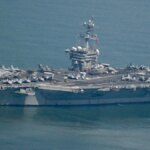
The US aircraft carrier USS George Washington began operations in the Arabian Sea, at a time when the United States is strengthening its military and naval presence in the region in conjunction with the continued US blockade imposed on ships heading to or departing from Iranian ports.
The US Central Command (Centcom) published scenes showing American sailors carrying out night flight operations aboard the carrier George Washington, while it was sailing in the Arabian Sea, an indication that it actually entered operational activity after its arrival in the region.
The scenes show continuous movement on the deck of the carrier and operations related to naval aviation at night, while Centcom said in its description of the scenes that “American sailors conduct night flight operations aboard the aircraft carrier USS George Washington while it is sailing in the Arabian Sea.”
The US Central Command had confirmed the arrival of the “George Washington” to the Arabian Sea as part of a scheduled deployment, to replace the aircraft carrier “USS Abraham Lincoln”, which spent a long period of deployment in the region.
“George Washington”, bearing the number CVN-73, belongs to the “Nimitz” class of nuclear-powered aircraft carriers, and hosts an air wing that includes fighters, aircraft and helicopters capable of carrying out a wide range of air and sea missions. The US Navy confirms that the carrier is the sixth of the “Nimitz” class, and bears the name of the first President of the United States.
These movements come in light of the presence of more than 20 American warships operating throughout the Middle East, according to the US Central Command, and participating in multiple military missions, including enforcing the US naval blockade imposed on Iran.
The spread of this number of ships does not mean that all naval vessels are exclusively designated for blockade operations, as American forces deployed in the region also carry out missions related to maritime security, supporting military operations, and monitoring navigation routes within the scope of Central Command’s responsibility.
On July 14, Washington resumed imposing the blockade on ships heading to and from Iranian ports and coastal areas, announcing at the time the presence of more than 20 warships and hundreds of American military aircraft in the Middle East.
According to the latest tally announced by Centcom, as of August 20, US forces have redirected 67 commercial ships since the resumption of the blockade, and also disabled 3 ships and boarded two ships to verify their compliance with the imposed measures.
Washington confirms that the blockade targets the movement of ships linked to Iranian ports, while its forces continue to monitor navigation in the Arabian Sea, the Gulf of Oman, and the vicinity of the Strait of Hormuz, at a time when the strategic sea lane remains at the heart of the confrontation between the United States and Iran.
US Secretary of Defense Pete Hegseth confirmed that the US Navy is able to continue the blockade of Iranian ports for an indefinite period, by rotating ships and military equipment operating in the region, as part of a strategy of continued pressure on Tehran.
The arrival of “George Washington” to the region came after its movement from the western Pacific Ocean, as the carrier group had left the Vietnamese city of Da Nang on August 5, and includes, in addition to the carrier, its air wing, the guided-missile cruiser “Robert Smalls,” and the destroyer “Shop.”
The entry of the new carrier into operational activity gains additional importance in light of the continued US naval buildup and the expansion of tasks related to the blockade and monitoring of shipping lines, while the publication of scenes of night flight operations constitutes a clear message that the deployment is not limited to a symbolic naval presence, but rather includes continuous air and operational readiness in one of the most sensitive maritime regions in the world.