October 27, 2026

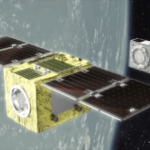
The Japanese company Astroscale proposes to use its innovative technologies – which it has previously tested in removing space debris and repairing damaged satellites – in building fleets of spacecraft to act as “bodyguards” to protect vital satellites from attacks by adversaries in orbit, according to what was reported by the “Space.com” website.
Astroscale previously achieved a historic achievement in 2024 by conducting a close examination of a neglected Japanese rocket stage as part of the “ADRAS-J” mission in low Earth orbit (below two thousand kilometers altitude), while its “ELSA-D” mission, between 2021 and 2024, represented the first commercial project to test capture technologies in this orbit.
In this context, the head of the company’s defense department, Alex Godfrey, explained on the sidelines of an event held in London earlier this month that the company is able to prepare a protection vehicle for launch in less than three years. Godfrey noted that orbital services operations require extreme levels of flexibility for docking and approaching up to 0 meters for refueling or removal, while space control requires a lower approach, making it simpler in some ways.
These proposals gain great importance in light of worrying Russian movements. The world watched in shock as Russian maneuvers closely targeted a radar satellite belonging to the Finnish Earth Observation Company “AISIE” last October. Experts described this incident as the first meeting between two active satellites in low orbit without the consent of the targeted party, amid fears that Russia would seek to harm the satellite, which provides Ukraine with vital intelligence information. US Undersecretary of State, Thomas DiNano, described these movements as “threatening behavior” and “consistent with weapons operations in orbit.”
This incident is only the latest in a series of Russian activities to eavesdrop on or jam Western satellites. The “Loach-1” and “Loach-2” satellites have been tracking European and American communications satellites in fixed orbit at an altitude of 36,000 kilometers since 2014. The commander of the German Military Space Command, Major General Michael Traut, admitted earlier this year that these satellites have been spying on European strategic communications for years.
Regarding the cost, Godfrey confirmed that the “bodyguard” mission costs only about one percent of the value of a military communications constellation in fixed orbit, such as the British “Skynet” fleet, which is worth 8.4 billion pounds sterling. Godfrey likened the matter to “an aircraft carrier group, where the carrier does not leave the port alone, but is accompanied by smaller, less expensive systems to protect it,” suggesting the formation of a joint European fleet of these vehicles to protect the satellite concentrations of allied countries.
Despite the leadership of Astroscale – which is based in Japan and has a large presence in Britain – in rendezvous and close-in operations technologies, no Western party currently possesses widespread capabilities equivalent to those possessed by Russia and China. According to a report by the “Secure World” Foundation, Europe in particular appears to be inadequately equipped for defensive and military operations in space.
For his part, the company’s general manager in Britain, Nick Schiff, revealed that “discussions” have been held with companies and customers across Europe, but no contracts have been signed to develop guard satellites yet. Schiff explained, “The British government promises to fund the development of space control starting in 2030, and what must happen now is to prepare the ground for possessing the appropriate capabilities, investments, and experimental models by that date.”
While these discussions continue, the Russian satellite “Cosmos 2612” is still hovering 480 kilometers from the “ISEI” intelligence satellite, which keeps the Western space community in a state of constant suspense.