October 26, 2026

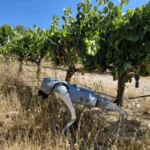
A pilot research project has been launched in Spain to test the capabilities of the four-legged robot “AgroHound” in monitoring crops on steep and rugged terrain, which constitutes an obstacle to traditional wheeled agricultural robots.
This project is led by the Spanish National Center for Agri-Food Technology (CTAEX) in the Extremadura region, as part of a consortium that includes the wine production company Bodegas Familiares Matarromira, the berry growing company Social Berries 4.0, as well as the technology partners Spectral Geo, Soltel, and the Prodetti Foundation. The project has joint Spanish and European funding, and is planned to continue until early 2029.
“Aggrhound” relies on a robotic platform equipped with advanced cameras and sensors. Unlike wheeled or tracked robots that struggle on slopes, loose soil and narrow rows, a legged mechanism allows each foot to be positioned independently, giving it superior ability to traverse rough terrain. As he tours, cameras and sensors feed custom AI models to assess the plants’ vitality, growth, and physiological state, as well as estimate expected production.
The first field tests of the robot are taking place in two different agricultural environments. The first is in the “Ribera del Duero” region, among the “Tempranho” grape vines in the “Matarromera” lands with sloping and terraced vineyards, and the second is in the province of Huelva in southern Spain, among blackberry seedlings planted inside long plastic tunnels on a farm belonging to the “Social Berries 4.0” company.
The project manager, Luis Muñoz, explained that the primary goal is to transfer the reliability of legged robots – used in industrial inspection – to the agricultural sector to overcome the obstacles of rough terrain. No performance data has yet been published due to the recent start of the trials, as the coalition is currently focusing on testing the platform’s ability to move efficiently in actual vineyard and tunnel conditions, in preparation for integrating more advanced sensor systems later.
On the other hand, legged robots face challenges represented by their mechanical complexity, and the high cost of manufacturing and maintaining them compared to their wheeled counterparts, due to the need for each leg to have independent motors and a balance control system, in addition to the relatively short battery life during continuous walking. For this reason, the current trial is viewed as a field test to verify the reliability of the robot over an entire season, including working in wet, loose soil and tight turns.
The project’s future plans include adding a spectral imaging system to draw an immediate map of fruit maturity, in addition to a robotic arm to collect samples of plants or fruits for laboratory analysis. If the initiative is successful, farmers will have the ability to rely on a single robot to navigate vineyards and farms, monitor sites of stress or disease, estimate the degree of maturity, and collect samples without the need for direct human intervention.