October 27, 2026

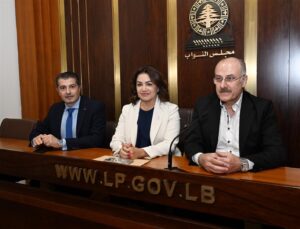
The Economic, Social and Environmental Council held, at the invitation of its Chairman, Charles Arbid, and the Chairman of the Board of Directors, General Director of the General Housing Corporation, Ronnie Lahoud, an extensive meeting devoted to discussing the “rent-to-own project and the prospects for housing security in Lebanon.” The Minister of Social Affairs, Haneen Al-Sayyid, and Representative George Okais participated in the session, in the presence of Deputy Speaker of the Council, Saad Eddin Hamidi Saqr, Director General of the Ministry of Affairs, Judge Hala Al-Mawla, President of the General Labor Union, Beshara Al-Asmar, Head of the Syndicate of Real Estate Brokers and Consultants, Walid Moussa, President of the Syndicate of Owners of Real Estate and Rented Buildings, Patrick Rizkallah, Vice President of the Chamber of Commerce, Industry and Agriculture, Nabil Fahd, Mazen Halawi, representing the Bank of Lebanon, President of the National Council of Lebanese Economists, Salah Asseiran, President of the Council. Municipality of Tripoli, Abdul Hamid Karima, President of the Keserwan Municipalities Union, Elias Baino, President of the Women Leaders Association, Madiha Raslan, President of the National Federation of Trade Unions and Employees in Lebanon, Castro Abdullah, President of the “Ogero” Employees Union, Emily Nassar, along with members of the Council and events interested in housing and economic affairs.
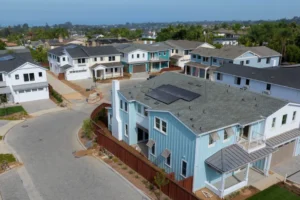
The meeting began with a presentation by Ronnie Lahoud on the housing reality, revealing a “national strategic roadmap for housing in Lebanon.” Lahoud stressed that achieving economic advancement and social security is based primarily on moving the housing wheel, announcing an opportunity to launch the process of housing loans and solar energy loans by 2027. He explained that the plan includes activating the corporation’s lands early next year; So that lands located in industrial areas are rented to industrialists, and lands in residential areas are allocated to build new housing units, in addition to encouraging municipalities and the private sector to reduce the housing shortage crisis. He also pointed out that the plan provides for long-term “ownership rent” for people with limited income who are unable to secure the first payment, in parallel with providing tax incentives to real estate owners and developers.
For his part, President of the Economic, Social and Environmental Council, Charles Arbid, stressed that housing is a social right and the basis for any stability and community protection, considering that the 2019 crisis and its banking repercussions froze a vital sector that allowed the poor to obtain facilities and loans. Arbid asked about ways to encourage young people to stay in the country in the absence of the minimum level of adequate housing, calling for the development of a sustainable and legislatively stable national policy for five or ten years, independent of government changes. He called for establishing economic and social stability based on production, expanding job opportunities, and equal opportunities to combat poverty and unemployment.
In the same context, Minister of Social Affairs, Haneen Al-Sayed, confirmed that the housing file is at the top of the urgent challenges in light of the successive crises and the repercussions of the recent war and the 2024 crisis. She indicated that the Ministry is working to breathe life into the housing institution and reactivate its role after years of paralysis, stressing the importance of formulating a first-of-its-kind national strategy in the country concerned with enshrining the citizen’s right to adequate housing, which will soon be submitted to the Council of Ministers. Al-Sayed announced the allocation of a financial allocation to the Housing Corporation within the 2027 budget as a foundational step for the return of its lending role, stressing that owning a home is not the only path to achieving stability, but there are other alternatives that include regulating and protecting the residential rental sector.
In turn, Representative George Okais touched on the legislative and parliamentary dilemmas facing regulating the relationship between landlord and tenant, warning of three main challenges: The first is the expiration of the legal deadlines for extending residential and non-residential rents, the second is how to fairly distribute social and economic burdens between owners with limited capabilities for maintenance and financially unequal tenants, and the third is the necessity of establishing transparency in parliamentary mechanisms through public committee sessions and the adoption of clear electronic voting before public opinion. Aqais called for a comprehensive and balanced approach that does not undermine the rights of owners or displace tenants, in preparation for radical reforms that save the sector from the policy of temporary solutions.