October 19, 2026

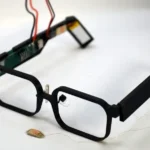
A team of engineers at Northwestern University has developed a prototype of smart glasses called “GlassTENG,” capable of monitoring health indicators without the need for traditional batteries, by exploiting the energy generated by natural facial movements such as blinking, smiling, moving the jaw, and raising the eyebrows.
The new technology relies on triboelectric nanogenerators (TENGs), a mechanism that takes advantage of contact and separation between flexible layers inside sensors to convert mechanical energy resulting from repetitive daily movements into electrical energy that powers the sensing system.
The researchers equipped the glasses with three sensors carefully distributed on the frame. The first is at the bridge of the nose to monitor the pulse, eye blinks, and eyebrow movement, the second is at the temple to monitor the pulse and jaw muscle activity, and the third is near the ear to monitor chewing and teeth clenching movements, with the resulting signals ranging between 50 millivolts and 1.5 volts.
To evaluate the prototype’s performance, the team used a machine learning algorithm that was tested on data from 20 volunteers, recording an overall accuracy of 93.8% in identifying activities, and 99% in identifying teeth chatter, while the average difference in pulse measurements compared to a chest reference belt was only 1.82 beats per minute.
Despite the promising results, the system faced challenges such as the difficulty of distinguishing between speaking and chewing, as the movements overlapped, reaching only 55% accuracy in recognizing speech, while it was incorrectly classified as chewing in 37% of cases due to similar muscle action.
Currently, the glasses rely on sending data via Bluetooth to a smartphone or tablet for analysis, but the research team plans to develop the system to process the data directly inside the frame, allowing immediate alerts to the user to reduce stress habits and teeth grinding.
GlassTENG technology is still in the prototype stage, requiring further testing and development before it can be adopted as a reliable tool available for widespread daily use in continuous health monitoring.