October 19, 2026

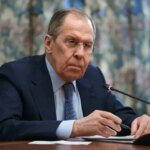
Today, Sunday, Russian Foreign Minister Sergei Lavrov directed sharp criticism at the United States, Europe, and Ukraine, touching on several sensitive regional and international files, including American policy toward Iran, the course of the Ukrainian war, and the position of Western capitals regarding Russian infrastructure.
Regarding the regional file, Lavrov stressed that the approach taken by the United States towards Iran “does not contribute to finding a solution or achieving stability in the region,” in a position that reflects the continued Russian-American disagreement regarding the Iranian file.
Regarding the Ukrainian issue, the Russian Foreign Minister stressed that Moscow had concluded that Ukrainian President Volodymyr Zelensky “does not want negotiations,” accusing him of obstructing them repeatedly in the past. He also accused European countries of trying to “save Zelensky’s regime by encouraging Ukrainian attacks on Russian infrastructure,” holding them responsible for pushing the escalation forward.
In a related context, Lavrov downplayed the importance of criticism directed at the Russian-American agreement on diesel, considering that the European Union and Zelensky’s description of this agreement as a “betrayal of Ukraine” is nothing more than a “media show.”
These positions coincide with remarkable shifts in American policy, as US President Donald Trump described his decision to suspend a number of sanctions imposed on Russia as “very good,” stressing that it would be in the interest of the entire world. Last Friday, Trump announced that Russia would be exempt from major sanctions and customs duties—which included duties on Russian goods and sanctions related to the purchase of oil and gas—a few days before they went into effect under a law he signed last month.
Lavrov’s statements reflect the continuation of fundamental differences between Moscow, on the one hand, and Kiev and European capitals, on the other hand, regarding the prospects for a political settlement and the course of the war, in parallel with their intersections with the new transformations in the American approach to sanctions and international crisis management.