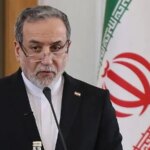
Iranian Foreign Minister Abbas Araqchi’s communication with the American envoy, Steve Witkoff, on the sidelines of the United Nations General Assembly meetings in New York, sparked a widespread wave of controversy within Iranian political circles. Criticism escalated from media outlets close to the Revolutionary Guards, reaching Parliament, amid parliamentary hints at the possibility of interrogating the minister to find out the motives for the call and its timing.
The objections focused on the official version, which stated that the communication aimed to inform Washington of Tehran’s conditions for ending the war and reopening the Strait of Hormuz. On the other hand, critical media outlets believed that these conditions had previously been conveyed to the American side through intermediaries, which raises questions about the feasibility of communicating again.
In this context, Tasnim Agency launched an attack on Araghchi, demanding that he provide clarifications and an apology, even though communication with Witkoff took place indirectly through Qatari mediation. In turn, the Fars Agency, which is close to the Revolutionary Guard, raised questions about the reasons for the contact, stressing that the Iranian conditions had previously reached Washington.
On the other hand, US envoy Steve Witkoff explained that the American and Iranian delegations held lengthy talks through mediators who were moving between the two sides. In turn, Iranian Foreign Ministry spokesman Ismail Baghaei confirmed that communication took place through the Qatari mediator with the aim of conveying Tehran’s conditions. In the same context, US President Donald Trump indicated the existence of contacts through mediators, indicating that Witkoff and Jared Kushner held a meeting that was described as “very constructive” with them.
The dispute extended to the Iranian Parliament, where the Deputy Chairman of the Article 90 Committee, Hossein Ali Haji Delijani, stated that the Council may resort to its oversight tools, including interrogating Araghchi. Representative Ibrahim Rezaei believed that conducting new communication after communicating the conditions in advance may be interpreted as a “sign of weakness,” demanding clarification of the legal and political basis for this communication.
In parallel, another controversy emerged over Iranian diplomat Nasser Assadi remaining inside the General Assembly Hall while US President Donald Trump delivered his speech, which sparked widespread local criticism, while Foreign Ministry spokesman Ismail Baghaei defended this step, considering that attendance in the hall is an essential part of diplomats’ duties.
These developments reflect a clear division within institutions and political movements in Iran regarding the mechanisms for managing communication channels with Washington, between an official trend that defends the continuation of communication through intermediaries, and critical parties demanding more precise explanations of the nature and timing of these communications in light of the continuing pressure and confrontation with the United States.