Today, Friday, southern Lebanon witnessed a widespread and unprecedented Israeli escalation in terms of the intensity of raids, artillery shelling, and bombings. The attacks affected dozens of towns and areas extending from the Tire district to Bint Jbeil, Nabatieh, Marjayoun, and Hasbaya, while severe tension remained in control of most of the southern regions until the evening hours.
Field information reported that Israeli warplanes raided a house on the outskirts of the town of Baraashit in the Bint Jbeil district, at a time when the town and its surroundings were subjected to additional bombing and bombings during the day.
The Israeli army had previously announced the targeting of a building in Baraashit, and said that forces from the “Kfir” Brigade, led by the 91st Division, spotted people who entered the building after they crossed the line that Israel considers the border of what it calls the “security zone,” claiming that they posed a threat to its forces, before the Air Force launched the raid on the building.
An Israeli artillery shell also targeted a house on the outskirts of the town of Shaqra, coinciding with the throwing of a sound bomb in the area, while artillery shelling continued on a large number of towns and areas throughout the day.
The Israeli bombing included Al-Mansouri, Ali Al-Taher Hill, Doha Kafr Rumman, Al-Dabsha Hill, Taloussa, Wadi Al-Hujair, and the outskirts of Shaqra, Bara’shit, and Mifdoun, in addition to artillery shelling that targeted the town of Hula and the vicinity of Mifdoun – Nabatieh Al-Fawqa.
The bombing was accompanied by intense sweeping operations with machine guns towards Qantara and Wadi al-Hujair, in addition to Zawtar al-Sharqiya, Hadada, Ayta al-Jabal and other areas, in light of active Israeli military movement along the southern strip.
At dawn today, Israeli aircraft launched a series of raids targeting Al-Mansouri, Al-Qantara, Ali Al-Taher Hill, and Doha Kafr Rumman, before the raids expanded during the daylight hours.
In a later development, Israeli warplanes launched two raids on the town of Beit al-Siyad, a small village containing about 50 homes, in one of the most brutal field incidents during the day.
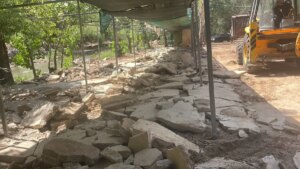
According to information received from the region, the two raids, after a series of attacks on the town previously, led to the destruction of what remained of its homes, until the village, according to circulating field data, was left without almost any intact house.
The air strikes were accompanied by a widespread wave of Israeli bombing operations in a number of towns, as a very violent explosion was heard in the town of Arnoun, which echoed over a wide area of the south, before a second explosion was recorded in the town.
Israeli forces also carried out a large bombing in the town of Kafr Tibnit, in conjunction with other bombings targeting Majdal Zoun, Masha’ al-Mansouri, and the town of Mansouri.
Bombings were also recorded in the town of Hadada, the vicinity of the town of Taiba, and the town of Markaba, while a bombing occurred on the outskirts of Baraashit, from the side of the town of Aitaroun, followed by a second bombing within the area of Baraashit.
In parallel with the bombings, information reported that Israeli forces burned homes in the town of Beit Yahoun, as part of a series of bombing and burning operations that affected buildings and homes in a number of southern towns.
An Israeli aircraft also threw a sound bomb over the town of Al-Mansouri, while another incident was recorded in Shebaa after an Israeli aircraft threw a sound bomb towards a cattle herder, wounding him and transporting him to the hospital for treatment.
This escalation comes at a time when the area of Ali Al-Taher Hill and the surroundings of Nabatieh have been witnessing continuous tension for days, with the highland and adjacent areas exposed to a series of raids, artillery shelling, and sweeping with various weapons, amid great field sensitivity related to the location of the hill and its supervision over a wide area of the south.
The recent developments gain additional importance because they coincide with the continued discussion of implementing the “Framework Agreement” and the experimental areas in the south, amid Lebanese demands for the withdrawal of Israeli forces and the expansion of the Lebanese army’s deployment in the areas from which Israel withdraws.
Deputy Prime Minister Tareq Mitri had announced that the Lebanese army was ready to take over Ali Al-Taher Heights, while stressing that Lebanon wanted to restore its full sovereignty over the south, and that it did not want the region to remain without international monitoring.
The day of escalation also coincided with the visit of Prime Minister Nawaf Salam to the south, where he stressed the support of the army and security forces and the right of the people of the south to have the state by their side, while explosions sounded and Israeli raids were recorded during his presence in the region.
The attacks come within a phase that is witnessing an expansion in bombing, bulldozing, and burning of homes in a number of southern villages, after similar operations were recorded during the past days in Khiam, Kafr Benit, Taloussa, Al-Mansouri, Hula, Markaba, Majdal Zoun, and other areas.
The bombings of homes and residential neighborhoods raise increasing concerns about the extent of the destruction that people will face when they return to their towns, especially in small villages that have lost a large percentage of their buildings and homes, which is clearly evident in the case of Al-Siyad Houses, which were originally one of the smallest residential communities in the region.
The continued bombing, raids, and bombings add a new obstacle to any path of reconstruction or the return of residents, as the repercussions do not stop at direct damage, but rather include agricultural lands, infrastructure, roads, homes, and people’s sources of livelihood.
As evening arrived, most areas of the south remained under intense tension, while Israeli operations were divided into air strikes, artillery shelling, bombings, sweeping operations, and the throwing of sound bombs, in one of the most intense days of escalation during the recent period.