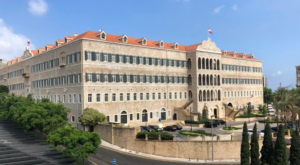
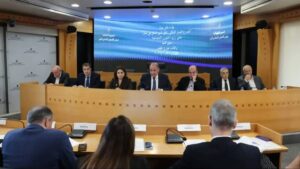
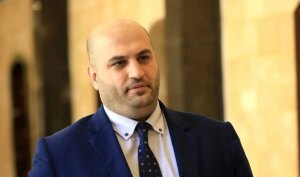
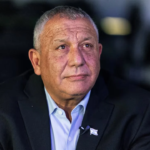
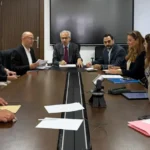
Deputy Speaker of the House of Representatives Elias Bou Saab and a number of heads of parliamentary committees in the House of Representatives received a delegation from the “American Action Group for Lebanon” headed by former Ambassador Edward Gabriel, where an expanded meeting was held that included Bou Saab and the committee chairs, Representatives Fadi Alama, Farid Bustani, Tony Franjieh, Inaya Ezzedine, Ghayath Yazbek and Hassan Murad, in addition to Representative Melhem Khalaf.
The meeting was devoted to discussing political, security and economic developments in Lebanon, especially the situation in the south, the future role of the United Nations Interim Forces in Lebanon (UNIFIL), the implementation of Resolution 1701, and support for the Lebanese army, as well as the path of economic and financial reforms and the relationship with the International Monetary Fund.
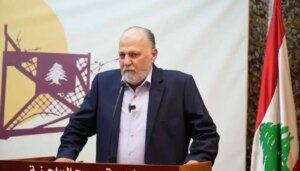
Khalaf began the discussion by emphasizing the presence of a clear parliamentary majority that affirms the need for the continued presence of UNIFIL and its role in the south, presenting a relevant letter signed by two-thirds of the members of the House of Representatives that reflects this parliamentary approach. He stressed the importance of maintaining an international presence that contributes to protecting stability and preventing a security vacuum in the region.
For its part, the delegation raised questions regarding the renewal of UNIFIL’s mandate, focusing on the issue of actual verification and monitoring of any future agreement or security arrangements. The discussion discussed more than one possibility for a verification mechanism, whether through UNIFIL itself, or through an American role, or through a third country or international body, with reference to European discussions in this context.
The delegation of the American Action Group for Lebanon stressed that the Israeli objection to UNIFIL constitutes a factor that should be taken into consideration and addressed within any viable future formula.
In turn, Chairman of the Foreign and Expatriate Affairs Committee, Representative Fadi Alama, stressed the importance of maintaining an international presence based on international legitimacy and United Nations resolutions, stressing that the ultimate goal must remain to establish the sovereignty of the Lebanese state and secure the conditions that allow the population to return to their areas.
Alama considered that the international role must support Lebanon’s sovereignty and stability, and not constitute an alternative to state institutions.
For his part, Chairman of the National Economy, Industry, Trade and Planning Committee, Representative Farid Al-Bustani, pointed out the importance of benefiting from American interest in Lebanon and the presence of figures of Lebanese origin in influential positions in the United States, which will contribute to mobilizing more support for Lebanon in the next stage.
Regarding the security file, Al-Bustani stressed that the permanent solution cannot be through an army or an international force that replaces the Lebanese state, but rather through strengthening the Lebanese army and enabling it to fully carry out its responsibilities on Lebanese territory.
Head of the Women and Children Committee, MP Inaya Ezz El-Din, addressed the human dimension of events in the south, focusing on the conditions of women, children, displaced persons, and the civilian population, and the fear, displacement, destruction, and violation of people’s dignity that the war left behind.
Ezz El-Din warned that the continuation of this reality would reproduce a new spiral of violence and instability, considering that achieving sustainable peace requires addressing the root causes of the crisis, ending Israeli attacks, and ensuring the safe return of the population, in parallel with rebuilding a state capable of providing rights, security and prosperity to all Lebanese away from sectarian divisions.
As for the Chairman of the Environment Committee, Representative Ghiath Yazbek, he provided a critical reading of UNIFIL’s performance during the previous stages, pointing out that the experience showed the limitations of its ability to carry out its tasks in the required manner, especially during previous stages, most notably the 2006 war, in addition to its inability to monitor the development of military structures on the ground.
Yazbek saw the need to search for a more effective formula that has higher powers and authority and a greater ability to monitor and implement, stressing at the same time the need to stop the Israeli attacks immediately, and pointing to the extent of the damage caused to the south, including villages, agricultural lands and the natural environment.
For his part, Bou Saab explained that objection to the performance of UNIFIL does not necessarily mean rejecting its existence or calling for its abolition. Rather, a large portion of critics demand a mechanism with higher authority and more effective powers that would enable it to actually perform its mission and ensure the implementation of commitments on the ground.
He stressed that the most prominent development at the internal level is the presence of a broad trend towards weapons and security authority being in the hands of the Lebanese state and the Lebanese army, stressing that strengthening and supporting the army on an ongoing basis remains the basis of any sustainable solution.
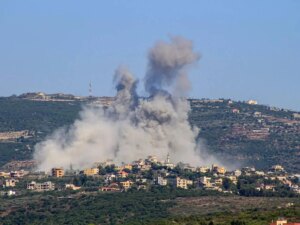
Regarding the situation in the south, Bou Saab considered that what is happening can no longer be reduced exclusively to the Hezbollah issue, in light of the destruction of villages, lands and trees in the region, the fall of civilian casualties, and the continuation of Israeli operations, expressing his concern that the continuation of these attacks in light of the weak international reaction undermines the chances of reaching any serious agreement.
He stressed the importance of the United States and the international community playing a more active role in supporting negotiations and pressing towards a workable settlement, with a mechanism to verify the implementation of commitments from all parties, especially the Israeli side, calling on the delegation to unite and put pressure towards this goal.
Speaking about Resolution 1701, Bou Saab pointed to the large number of Israeli violations, pointing out that any commitment to any resolution must be complete by all parties.
He touched on the regional dimension of the crisis, considering that Lebanon cannot be completely separated from the ongoing conflicts in the region, and that the end of the regional confrontations or a decline in their intensity would put Lebanon in a better position and help it restore stability.
Bou Saab expressed his optimism about the future of Lebanon, considering that the country has the ability to rise once security and stability are achieved. He called on the delegation of the “American Action Group for Lebanon” to encourage investment and take advantage of the opportunities that currently exist, considering that the current stage, despite its difficulty, may provide important investment opportunities for those who look to Lebanon in the long term.
The discussion then moved to the economic and financial file, where Paul Salem raised the issue of the agreement with the International Monetary Fund, stressing that reaching an agreement constitutes an essential factor in restoring investor confidence in Lebanon, and asking about the expected time frame for completing this path.
In this context, Al-Bustani pointed to progress in discussions related to restructuring the banking sector, and to the presence of parliamentary support to complete the agreement with the International Monetary Fund, pointing out that the government is working on a draft law that is expected to reach the House of Representatives in the next stage.
As for Bou Saab, he stopped at the roots of the financial crisis, explaining that the state borrowed from the Bank of Lebanon, and that the Bank of Lebanon in turn provided incentives to the banks through high interest rates, while the banks used depositors’ money in these operations, so that the money was practically transferred from the depositors to the banks, and from there to the Bank of Lebanon, and then to the state’s financing and spending.
He stressed the need for determining responsibilities in the crisis to be fair, and for depositors not to bear the cost of the financial collapse alone, calling for a comprehensive treatment that distributes responsibilities and losses fairly, protects the rights of depositors and restores confidence in the financial sector.
The meeting concluded by emphasizing that addressing Lebanon’s crises requires an integrated approach that combines strengthening the sovereignty of the state and the Lebanese army, creating a more effective international framework to ensure security and implementing international resolutions, stopping Israeli attacks and securing the return of residents to the south, and advancing economic and financial reforms, in parallel with rebuilding international confidence in Lebanon and encouraging investment in it.