“Lebanon Debate”
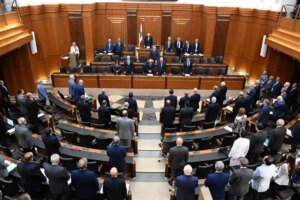
Between what was said about the banking reform law after its approval, and what was actually settled in its final text, there is a large gap that may change many of the conclusions that accompanied the parliamentary session.
Most of the readings and positions were launched before the final version had been completed, while returning to the approved text reveals that what remained between the lines is more important than the noise that surrounded its approval.
It is noteworthy that the General Assembly’s amendments were limited to Article 3 and one paragraph of Article 11, while the rest of the articles remained identical to the formula approved by the Finance and Budget Committee. And here precisely the surprises begin: articles related to the recovery of funds and accounting, the fortification of deposits, and on the other hand, a problem opened by Article 3 regarding the independence of the Bank of Lebanon.
These data alone are sufficient to put a large part of what was said about the law under review, and open the door to a completely different reading of what was actually approved.
Article 13 requires the recovery of transfers made by politicians and influential people abroad after October 17, 2019, while Articles 14 to 29 outline a strict path for scrutiny and accountability at various levels, all the way to politicians, officials, and bank owners.
Hence, it is not unlikely that the adoption of the law will open the door to a series of appeals before the Constitutional Council, especially from parties affected by its effects or who object to some of its articles.
As for the most prominent battle, it revolved around Article 23, which was approved by the General Assembly in accordance with the amendment of the Finance and Budget Committee. This amendment linked the deposit recovery mechanism to the Financial Regulation Law, which provided deposits with strong legal protection, despite the objection of the government, the International Monetary Fund, and a number of representatives who support their approaches.
The same protection was withdrawn to Appendix No. 1, as the Finance and Budget Committee added to the clause excluding deposits from the loss absorption table, the condition of approving and implementing the Financial Regulatory Law, an amendment that the General Assembly kept without change.
Thus, the final text appears different from the picture painted by some hasty analyses. The law did not pass according to the government formula as it is, but rather carried basic fingerprints of the Finance and Budget Committee, whether at the level of accounting and recovery of transfers, or in terms of linking any treatment of losses to the law of financial regulation and protecting the rights of depositors.
As for Article 3, it witnessed clashes between those who wanted the government formula and those who wanted to maintain the amendment introduced by the Finance and Budget Committee to protect the independence of the Bank of Lebanon.
As a result of the vote, the government formula was adopted, which removed the law from the ceiling of the Monetary and Credit Law, at the request of the Hezbollah bloc, and a number of change representatives and others agreed with it, which undermined the independence and effectiveness of the Bank of Lebanon.
However, the information indicates a move to correct this defect, either through the President of the Republic’s response to the law, or through submitting a duplicate expedited law proposal to amend this article.
The real test remains in implementation: Will the accounting and money recovery articles turn into actual measures that affect politicians, influential people, and bank owners, or will the battle to disrupt the law begin through appeals and contradictory interpretations?