The administration of US President Donald Trump has expanded its diplomatic contacts with European countries, in a new move aimed at increasing pressure on Iran and trying to break the stalemate that is overwhelming efforts to end the war and put negotiations back on track.
According to the Associated Press, the American move comes as Iran continues its contacts with the Sultanate of Oman, Pakistan, Turkey and Qatar, amid an increasing hardening of Tehran’s positions and continuing disputes over the Strait of Hormuz and the outstanding issues between the two sides.
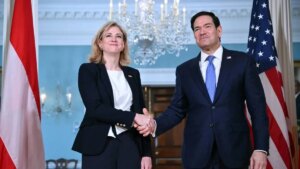
In this context, US Secretary of State Marco Rubio met his Austrian counterpart Beate Meinel-Reisinger in Washington on Tuesday, before he held a call the next day with Greek Foreign Minister George Gerapetritis.
Although the official US statements did not explicitly refer to Iran, a remarkable development emerged a short time later, as the foreign ministers of Austria and Greece held separate communications on Thursday with Iranian Foreign Minister Abbas Araghchi.
The Associated Press quoted a European diplomat familiar with the file as saying that the coincidence of these contacts “was not a mere coincidence,” which indicates an American attempt to expand the circle of parties capable of communicating with Tehran and push it toward returning to the negotiating table.
Austria’s entry into the line is of particular importance given that Vienna hosts the headquarters of the International Atomic Energy Agency, as well as its previous role in hosting the final negotiations that led to the Iranian nuclear agreement in 2015.
As for Greece, its importance emerges from a different angle, as it is a maritime power with direct interests in the security of navigation and the movement of ships through the Strait of Hormuz and the Red Sea, at a time when the Strait crisis has become one of the most prominent points of political and economic clash between Washington and Tehran.
The Greek Foreign Ministry confirmed that Gerapetritis received a briefing from Araghchi on regional developments, especially the talks related to the Strait of Hormuz, and stressed the importance of freedom of navigation and maritime security.
In turn, Austria offered to host any future talks on Iran, while its Foreign Minister stressed during her call with Araqchi the need to restore stability through a diplomatic path, considering that a military solution cannot constitute a way out of the crisis.
But expanding the circle of communications does not necessarily mean the emergence of a new European mediation capable of achieving rapid penetration. Mona Yacoubian, director of the Middle East Program at the Center for Strategic and International Studies, warned that Austria and Greece can encourage the two sides to return to dialogue, but actual mediation requires a deeper level of trust and relations with the two parties.
These moves come at a sensitive moment, with the continuing US-Iranian dispute over the future of the Strait of Hormuz, the US naval blockade, and the Iranian nuclear program, in conjunction with regional and international attempts to prevent the collapse of the diplomatic track and a return to a broader military confrontation.