The scholar, Mr. Ali Fadlallah, warned against keeping Lebanon and the region prisoners of temporary truces, considering that all possibilities remain possible regarding any new Israeli adventure, and at the same time calling for fortifying the Lebanese interior, unifying ranks, and staying away from debates and divisions.
Fadlallah’s position came during a dialogue meeting held at the Islamic Cultural Center in Haret Hreik under the title “Purposeful Missionary Positions from the Life of the Prophet,” in which he discussed the most prominent features of the Prophet’s personality and his missionary journey, and answered questions related to the latest developments in Lebanon and the region.
He stressed that the Messenger of God was the most complete model for humanity in his knowledge, worship, morals, wisdom, courage, justice, humility, and his dealings with people and his love for them, noting that his message came to bring mankind out of the darkness of ignorance, backwardness, and fanaticism into the vastness of awareness, faith, and openness.
He pointed out that the mercy that filled the heart of the Messenger of God and appeared in his words and stances was the key to people’s hearts and minds, stressing that loyalty to the Messenger of God is not only through slogans, but rather through imitating his morals and conduct, and emulating his sincerity, honesty, forbearance, forgiveness, gentleness in his speech, purity of his heart, and good dealings with people.
Regarding the Lebanese issue, Fadlallah warned against the region remaining captive to temporary truces, stressing that all possibilities remain possible regarding any new adventure by Israeli Prime Minister Benjamin Netanyahu, and that caution is a must as long as radical solutions have not yet come.
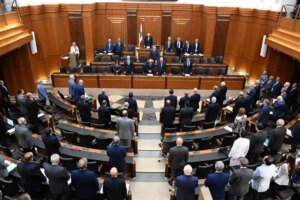
He criticized the heated debates within the Parliament, considering that at a time when Israel is demolishing and bulldozing villages and continuing its attacks, and instead of focusing the effort on fortifying the homeland, reclaiming lands, and unifying the internal ranks, some are busy with discussions and laws that are predominantly sectarian and self-interested.
He stressed that justice must be for every oppressed person, but not at the expense of the interest of the nation or the logic of the state, stressing that Lebanon needs to move from the mentality of sects, sects, and quotas to the mentality of the state, and for the interest of the citizen and the nation to be a top priority, away from turning justice into a material for bargaining.
On the issue of media regulation, Fadlallah stressed that what is required is to regulate the media in a way that preserves its freedom and its role in revealing the facts, warning that regulation will turn into a means of tightening its grip on this necessary outlet for the truth.
He stressed the need to raise political and media discourse to the level of responsibility, stressing that the difficult stage that Lebanon and the region are going through requires unity, patience, wisdom, dialogue, and staying away from the language of insults and insults, because the country cannot tolerate more divisions.
Regarding the “Mecca Joint Defense Agreement,” Fadlallah expressed his hope that it would expand to include other Arab and Islamic countries, and that the participating countries would work to develop an Arab and Islamic strategy to protect the region with their own capabilities, away from Western hegemony and international tensions, and in the face of Israeli ambitions.
He concluded by stressing that the current stage makes the region most in need of uniting around an Arab and Islamic strategy to protect it, preserve its independence and the interests of its peoples, and build its future away from domination and subordination.