October 18, 2026

“Lebanon Debate”
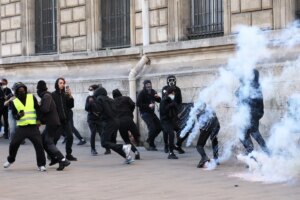
From Semaan Gallery to Bechara El Khoury and Saadiyat, to the crisis of owning real estate in Northern Matn, security incidents and field movements continue to raise concerns about the internal situation in Lebanon, and re-raise questions about the state’s ability to impose its prestige and control the street, in light of the escalation of political tensions and the lack of consensus between the Lebanese forces. Among fears of the expansion of tensions and their transformation into confrontations whose repercussions are difficult to contain, the possibilities of a security explosion remain open on several paths, amid anticipation of what regional developments will lead to, especially in Syria.
In this context, writer and political analyst Sarkis Abu Zeid warns, in an interview with Lebanon Debate, that the accumulation of political and security crises, coupled with the weak ability of the state to impose its authority and the absence of internal agreement, may push the country towards dangerous developments, without certainty of the possibility of returning to an atmosphere of civil war.
Is Lebanon approaching an internal security explosion?
Abu Zeid said that the internal situation does not call for reassurance, in light of the absence of an effective political agreement, and the inability of the political forces to implement what they want or contain the escalating tensions, indicating that political tensions and security unrest are increasing, in parallel with other problems, including smuggling and multiple security and political issues, which exacerbates internal contradictions and disputes.
He pointed out that the state does not seem able, in his estimation, to impose its security authority in the required manner, considering that addressing these situations cannot be achieved without internal consensus and agreement among the Lebanese, which is still absent until now.
He warned that the continuation of these conditions may lead to the accumulation and interaction of tensions, leading to a limited security explosion, the repercussions of which may develop in a way that is difficult for anyone to estimate its results. However, he did not confirm the possibility of a civil war breaking out, stressing the need to monitor regional and international developments to know the direction Lebanon will take.
Will the atmosphere before 1975 be repeated?
Regarding the similarities between the current stage and the atmosphere that preceded the outbreak of the Lebanese Civil War in 1975, Abu Zeid believed that the comparison does not allow, at the present time, to make a final judgment regarding the path that the country may take.
He explained that Lebanon’s future remains linked to regional and international developments, especially what the situation in Syria will turn out to be, and the nature of its relations with neighboring countries and regional powers, in light of the competition between Turkey, Saudi Arabia, other Arab countries, and Israel for influence and influence.
He pointed out that some parties may try to lure Syria into performing regional roles, including roles in Lebanon, considering that any potential Syrian intervention may have influential repercussions, given the size of the Syrian presence in Lebanon and the direct impact of Syrian developments on the Lebanese reality.
He stressed that identifying similarities between the current stage and the pre-civil war stage requires waiting to see what the situation in the region will lead to, rather than anticipating events or asserting their results.
Does the potential Syrian role constitute a factor in igniting strife?
In response to a question about whether he feared that the potential Syrian role would turn into a factor for stirring up strife in Lebanon, Abu Zeid answered in the affirmative, warning that the nature of this role might have security or sectarian dimensions, depending on the circumstances in which it might arise.
He pointed out that the number of Syrians in Lebanon exceeds one million, according to his estimate, considering that the presence of this population bloc, if divisions escalate or regional developments take a sectarian turn, may turn into a factor of political and security weight in some regions.
He added that this possibility requires careful monitoring of what is happening in Syria, because the nature of the transformations there and their repercussions on regional relations may directly affect Lebanese balances.
Abu Zeid concluded by stressing that the Lebanese scene is still open to multiple possibilities, and that determining the direction of the next stage is linked to the transformations that the region will witness, especially in Syria, in addition to the ability of the Lebanese forces to reach an internal understanding that reduces tensions and prevents political differences from sliding into broader security confrontations.