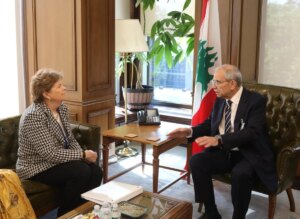
The Speaker of the House of Representatives, Nabih Berri, received at the headquarters of the Second Presidency in Ain al-Tineh an expanded delegation from the “Bekaa Development and Belonging” meeting. The delegation included the Mufti of Zahle and the Bekaa, Sheikh Ali Al-Ghazawi, the Mufti of Baalbek and Hermel, Sheikh Bakr Al-Rifai, Archimandrite Elie Bou Chaaya, Judge Sheikh Daniel Saeed, former Deputy Speaker of the House of Representatives Elie Al-Ferzli, MPs: Hassan Murad, Qabalan Qabalan, Wael Abu Faour, and Salim Aoun, and former MPs: Jamal Al-Jarrah, Assem Araji, Elie Marouni, and Muhammad Al-Qaraawi, in addition to To the President of the Chamber of Commerce, Industry and Agriculture in Zahle and Bekaa Mounir Al-Tini, Sheikh Ziad Haifa and Sheikh Nader Jumaa.
The delegation presented the Council President with the objectives of the “Bekaa Development Meeting” and the results of the conference held in Azhar Al-Bekaa, presenting him with the recommendations it reached. The meeting discussed all development issues that concern Lebanon and the Bekaa in particular, most notably the Dahr al-Baydar Tunnel Project and its importance in enhancing communication between the Bekaa and the rest of the Lebanese regions, and the necessity of completing the Arab Highway for its role in stimulating economic movement, in addition to a number of national affairs.
After the meeting, Al-Ferzli confirmed that the initiative launched by the Mufti of the Bekaa brought together various religious, political and economic activities in the region, affirming the unity of Lebanon, land, people and institutions, and the return of the displaced to their homes, and demanding what he described as “the rights of the historically digested Bekaa.” He pointed out that these rights include projects for which laws were issued in the House of Representatives, such as the Arab Highway and the Beirut-Bekaa Tunnel, in addition to industrial pollution files.
Al-Ferzli pointed out that the research also touched on the role of municipalities in development, the file of real estate owned by the Lebanese state, and how villages and expatriates benefit from it through legislation of an appropriate law in coordination with the Minister of Finance, Yassin Jaber. He stressed the continued follow-up of these files and communication with Prime Minister Nawaf Salam upon his return, praising Berri’s support for the proposed development projects.
In a separate context, Berri received the President of the African Continental Council at the Lebanese Cultural University in the World, Consul Hassan Yahfoufi, and members of the Council, in the presence of the official of the Amal Movement’s Central Foreign Relations Office, Ali Hayek. During the meeting, the general situation and the situation of the Lebanese communities on the African continent were reviewed, and the role of diaspora in the current stage, in addition to the Council’s work programs and preparations for holding its general conference on December 22, 2026.
Yahfoufi explained that the discussion addressed the difficult circumstances that Lebanon is going through, especially the developments in the south and the resulting displacement and humanitarian and economic damage, stressing the council’s readiness to contribute to any initiative that supports the people of the south and supports them in the process of reconstruction. He also stressed the importance of the role of expatriates in maintaining the link between resident and expatriate Lebanon, considering that the upcoming African Continental Conference will constitute a station for joint expatriate work and the formulation of a vision for the next stage.
Berri concluded his meetings by receiving former Minister Ghazi Al-Aridi, where political and field developments and a number of general national affairs were presented.