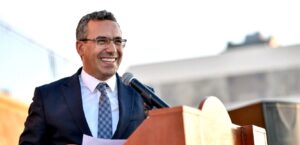
The Minister of Finance, Yassin Jaber, reviewed an integrated road map for financial and economic reform and restructuring of the banking sector, during a dialogue session organized by the “Leaders Club” at the “Le Gabriel” Hotel in the Achrafieh area. The session, which lasted for more than two and a half hours, witnessed the presence of more than 100 officials, experts, economists, and heads of economic bodies, including former Deputy Prime Minister His Excellency Al-Shami, and former Finance Ministers Raya Al-Hassan, Ghazi Wazni, and Sami Haddad, in addition to Freej Sabounjian, and Representative Mark Daou. Jaber stressed during the meeting that restoring confidence in the state and the economy requires an urgent transition from crisis management policy to building sustainable institutions and clear and regular rules.
Regarding the banking issue, the Minister considered that restructuring the sector is at the forefront of the recovery path, noting the approval of the law on resolving the conditions of banks and its signing by the President of the Republic as a legal framework for dealing with banking institutions, whether viable or unviable. He also discussed the work process on the Financial Gap Law, which aims to address losses and establish clear mechanisms to restore depositors’ rights, ensuring the continuity of the banking sector.
In terms of financial sustainability, Jaber stressed the importance of medium-term planning, pointing to the preparation of the 2027 draft budget within a five-year financial framework. He explained that tax policy focuses on increasing revenues by expanding the tax base, improving collection, combating evasion, and enhancing compliance, away from imposing random increases in tax rates. In this context, he revealed preparations to launch the “Bill Lottery” project as a prelude to implementing mandatory electronic billing, as well as subjecting foreign digital services consumed in Lebanon to tax.
Regarding the administrative reform file, Jaber indicated that plans are to be kept pace with a broad path for digital transformation in the Ministry of Finance and public administrations. The majority of transactions are now carried out through electronic platforms, with the option of electronic payment available in Lebanese and American currencies. He also referred to the digitization of real estate services and the modernization of the “Najm” customs system with the support of the World Bank and the European Union.
As for the electricity sector, the Minister of Finance stressed that addressing the accumulated financial burdens requires reorganizing the sector and separating the tasks of production, transmission and distribution, while making room for private sector participation. He also stressed the centrality of partnership between the public and private sectors to implement infrastructure projects, with a commitment to maintaining state ownership of strategic assets.
Regarding the reconstruction efforts, Jaber pointed out the work to activate the “LEAP” facilities supported by the World Bank to secure financing amounting to one billion dollars, which includes an initial commitment of 250 million dollars in addition to French contributions. On the monetary side, he highlighted the importance of permanent coordination between the Ministry of Finance and the Bank of Lebanon to control liquidity, maintain monetary stability, and exchange rate stability.
The Minister of Finance concluded by stressing that Lebanon possesses the human and economic capabilities that qualify it to advance, pointing out that the most prominent challenge lies in moving beyond the management of successive crises towards building institutions capable of working according to sustainable rules that restore confidence and enhance the economic and financial solvency of the state.