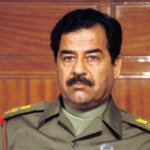
The Iraqi pilot, Captain Nimir al-Janabi, narrated unknown details about trips during which he accompanied the late Iraqi President Saddam Hussein, speaking about the strict security measures and funny situations that accompanied his movements.
In an interview with the “Best Saying” program on RT Arabia, Al-Janabi recalled the most prominent trips he remembers, most notably Saddam’s trip to Havana in 1979 to participate in the Non-Aligned Movement conference.
He said that preparations began before the arrival of the Iraqi president, as five cars similar to Saddam Hussein were transported to Cuba, along with an ambulance, and then a large shipment of Iraqi-made ventilators, presented as a gift from the Iraqi people to the Cuban people.
But the gift turned, according to Al-Janabi’s account, into a funny situation, after the Cubans tried to operate the fans and discovered that they did not work, due to the Cuban electricity network relying on 110 volts, while the Iraqi fans were designed to operate on 220 volts, so that the cost of the transformers needed to operate them was, according to his account, higher than the value of the fans themselves.
On the return trip from Havana, Al-Janabi explained that Saddam had traveled on a “707” plane, while he returned on a “jumbo” plane, amid careful security arrangements.
While crossing the Atlantic Ocean, the plane encountered strong turbulence and a weather storm in the Bermuda Triangle, before the crew received instructions to change the flight path from Casablanca to Paris, then to London.
Al-Janabi said that Saddam was sitting in the presidential cabin on the upper floor, while his son Qusay, who was about 8 years old, was conveying his father’s instructions to the pilots via scraps of paper.
When the plane landed in London to refuel, Saddam remained on board while the plane underwent British inspection procedures.
Al-Janabi also spoke about extensive security preparations for Saddam’s visit to New York to participate in the United Nations meetings, explaining that security and intelligence services were in charge of the arrangements, and that Barzan al-Tikriti and Adel Saeb Shawkat al-Jubouri made preliminary visits to New York.
According to his account, about 1,500 apartments were rented on the road between Saddam’s residence and the United Nations headquarters to be used to secure his route, and a bullet-proof platform was prepared for him in East Germany.
In Tunisia, during one of the Arab summits, Al-Janabi narrated that the protection personnel accompanying Saddam were prevented from leaving the plane with their weapons.
He added that a similar procedure was repeated during Saddam’s trip to Taif after the liberation of Al-Faw, where Saudi F-16 fighter planes accompanied him to the Iraqi border.
Al-Janabi’s novels reveal an aspect of the nature of Iraqi presidential trips at that stage, where highly complex security arrangements were mixed with personal details and unexpected situations.