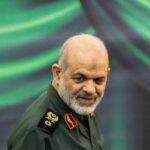
The commander of the Iranian Revolutionary Guard, Ahmed Vahidi, sent a strongly worded message to the Iranian armed forces and their allies, considering that the fighters had succeeded, during the past six months, in “humilizing the most powerful army in the history of the world,” in reference to the United States, amid the continuing confrontation and tension between Tehran and Washington.
In a message he published on the occasion of the month of Rabi’ al-Awwal, Vahidi praised what he described as the “unique jihad” waged by Iranian forces during the past months, speaking about military operations carried out in difficult climatic and field conditions and on different fronts.
Addressing the forces, Wahidi said: “You fought successful battles in the scorching heat of the islands and southern beaches, and in the cold of the high northern border areas, and you succeeded in carrying out offensive and defensive operations under heavy barrages of fire.”
The Commander of the Revolutionary Guard directed his message to those he described as “the fighters of Islam, the protectors of the homeland, policemen, members of the Basij and clans, and the unknown soldiers of Imam Mahdi,” praising the roles of the various agencies and forces participating in the operations.
Vahidi likened what he described as the forces’ steadfastness during half a year to previous military stages and stations in Iranian and Islamic history, considering that the fighters revived the “sacred defense epic,” which is the Iranian name for the Iran-Iraq war that lasted between 1980 and 1988. He also recalled the battles of Badr and Khaybar.
The message also carried direct praise for Mojtaba Khamenei, as Vahidi spoke of “the wise management of the field under the leadership of the scholar, Sayyed Mojtaba Khamenei,” considering that this leadership “opened the doors of revolution to the oppressed in the world and proved that Islam can rule the world,” as he put it.
This speech comes at a very sensitive stage of the confrontation between Iran and the United States, with the continuing dispute over the Iranian nuclear program, the Strait of Hormuz, the naval blockade, and sanctions, in parallel with the faltering efforts aimed at reaching a political settlement that ends months of military escalation.
In recent days, the tone between Washington and Tehran regarding the Strait of Hormuz has escalated, as Iran adheres to its role in managing navigation traffic through the strategic corridor, while the US administration confirms its refusal to Tehran impose fees or restrictions on the movement of ships.
Vahidi’s statements gain additional significance because they come at a time when Washington is betting on intensifying economic and military pressure to push Iran towards an agreement, in exchange for an Iranian discourse that seeks to show that pressure, siege, and military operations have not succeeded in breaking Tehran’s ability to continue the confrontation.
The Revolutionary Guard is one of the most prominent centers of military and security power in Iran, and includes land, sea, and aerospace forces, in addition to the Basij forces. It also plays an essential role in Iran’s military strategy and in managing Tehran’s network of relations with its allies in the region.
At the end of his message, Wahidi stopped at Palestine and Lebanon, expressing his hope that the military developments that he described as “victories” would be a prelude to ending the suffering of the peoples of the region. He specifically mentioned Palestine and Lebanon, before congratulating the fighters and their families on the anniversary of the Prophet’s birthday.
The message reflects the Revolutionary Guards’ attempt to present the outcome of the past months as a stage of steadfastness and victory in the face of the United States, in parallel with raising the ceiling on political and military discourse at a stage in which the settlement between Washington and Tehran is still far from being resolved.