US President Donald Trump entered into the escalating controversy regarding the conditions of sailors aboard the aircraft carrier USS Abraham Lincoln, which spent more than 260 days deployed in support of US operations related to the war with Iran, refusing to consider its stay at sea long, at a time when concerns are increasing about the living conditions and mental health of its crew members.
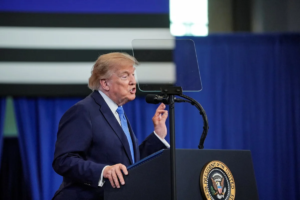
“No, no, no. It was not long enough at all,” Trump said, in response to a question from reporters about whether the carrier’s nearly 8-and-a-half-month deployment was too long.
At the same time, he revealed that the “Abraham Lincoln” is preparing to leave its deployment area, explaining that the ship “is moving now, or will move very soon,” and that another similar carrier will take its place.
The carrier left its main port in San Diego in November 2025, before it was later redirected to the Middle East to support American military operations in the war with Iran, carrying about 5,000 sailors and marines.
Trump’s statements come amid escalating controversy within the United States regarding the length of the mission, as the carrier has not docked in any port for more than 200 days, while Democratic lawmakers and the families of a number of sailors spoke of concerns related to mental health, living conditions, and supply problems.
On the other hand, US Defense Secretary Pete Hegseth rejected reports of deteriorating conditions on board the carrier, describing them as “completely distorted.”
In parallel with the controversy over “Abraham Lincoln,” Trump escalated his messages toward Iran and the Strait of Hormuz, publishing on his “Truth Social” platform an artificial intelligence-generated image showing him on board an Iranian oil tanker with the American flag next to him, and writing a comment on it: “It is our oil tanker now!”
The post came after Trump announced that the United States was imposing a naval blockade that, according to him, would allow it to control the passage of ships, coinciding with his confirmation of his intention to announce “very soon” that the Strait of Hormuz had become a territory belonging to the United States after what he described as “the defeat of Iran.”
This comes at a time when the Strait of Hormuz is witnessing escalating tension between Washington and Tehran, with the continued US blockade on Iranian ports and the faltering efforts aimed at reaching a settlement that guarantees the resumption of normal shipping traffic.