Prime Minister Nawaf Salam warned of the danger of the Israeli escalation witnessed in the south since dawn today, especially in the city of Nabatieh, the towns of Ansar and Deir Al-Zahrani, and the surrounding villages, considering that the raids, heavy bombing, and intimidation of people in their homes undermine efforts to stabilize stability.
Salam said, “The Israeli escalation witnessed since dawn today by the city of Nabatieh, the town of Ansar, Deir Al-Zahrani, and the neighboring villages, and the accompanying raids, heavy bombardment, and intimidation of people in their homes, is extremely dangerous and undermines efforts to stabilize the south.”
The Prime Minister rejected the Israeli justifications for the raids, stressing that “the martyrs of the Israeli raid on the town of Ansar al-Sabaa are not military infrastructure, and the children and women who were killed in it are not military targets.”
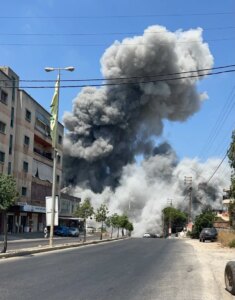
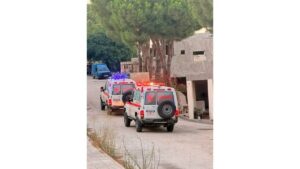
The Health Emergency Operations Center of the Ministry of Public Health announced that the final toll of the Israeli raid on the town of Ansar in the Nabatieh District amounted to 7 martyrs, including 3 children and 2 women.
Salam stressed that the responsibility for dealing with any military structures that may be present on Lebanese territory belongs exclusively to the Lebanese state, through the Lebanese army and the legitimate state institutions.
He said: “The responsibility for dealing with any military structures, if they exist on Lebanese territory, is exclusively the responsibility of the Lebanese state, through the Lebanese army and its legitimate institutions, and their presence does not give Israel the right to invade Lebanese territory or expose civilians to danger.”
This position is consistent with the discourse adopted by Salam over the past months regarding the exclusivity of state authority over Lebanese territory, as he had previously stressed that the protection of the south and the rest of Lebanon passes through a strong state and legitimate institutions capable of exercising its authority.
The Prime Minister called on Israel to stop the escalation, stressing that the protection of civilians and the right of residents to remain on their land cannot be part of any bargain.
Salam said: “Israel must stop this escalation. The security of our people and their right to live on their land is not a subject of negotiation or bargaining.”
His position came after very tense hours in the Nabatieh region, which began with a series of Israeli raids at dawn targeting Ali Al-Taher Heights, Nabatieh Al-Fawqa, and the town of Ansar, before the targeting was renewed later with a raid on Deir Al-Zahrani.
The Israeli army had announced, following the dawn raids, that it had targeted what it described as “the party’s infrastructure” in the Nabatieh and Ansar areas, claiming that its operations were in response to activity against its forces in the Ali al-Taher Heights area.
Hence, Salam’s position acquires a direct political significance, as it separates two issues: rejecting any military presence outside the authority of legitimate institutions, and at the same time rejecting Israel’s use of this matter as a pretext for carrying out military operations inside Lebanese territory and exposing civilians to danger.
The recent raids come in a very sensitive field context in the south, where the Lebanese authorities are seeking to stabilize the presence of the state and the army and return the people to their areas, in parallel with political and diplomatic movements aimed at securing complete Israeli withdrawal. Salam had confirmed during his visit to Zawtar Gharbiya in July that the government would continue to mobilize its political and diplomatic efforts to achieve withdrawal from all Lebanese territory.
The targeting of Deir Al-Zahrani today also brings the town back into the area of raids, after it had been subjected to raids on May 31 that, according to a published toll at the time, caused 8 martyrs and 16 wounded, and destroyed a number of homes.
The new escalation places the Lebanese government facing two parallel challenges: establishing the exclusivity of security and military decisions in the hands of state institutions on the one hand, and confronting Israeli attacks and preventing this internal path from being turned into a justification for continued raids on the other hand.
From this standpoint, Salam’s position carried a clear message in both directions, that dealing with any weapons or military structures inside Lebanon is the responsibility of the state alone, and that this does not give Israel, under any pretext, the right to carry out raids inside Lebanese territory or endanger the lives of civilians.