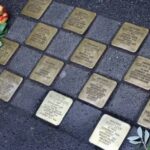
A local decision issued by the city council of Heidenau in the German state of Saxony sparked widespread controversy, following a vote in favor of stopping the placement of more “stumbling stones” dedicated to commemorating the victims of the Nazi regime in the streets and sidewalks, and moving the center of gravity of commemoration to the city cemetery.
According to a press report published by journalist Eli Leon in the Israeli newspaper “Maariv”, the decision came after a secret ballot that took place last Thursday evening, where 13 members approved the decision, while 6 members opposed and one member abstained, and the results were confirmed through official German reports.
The proposal was jointly presented by representatives of the Christian Democratic Party (CDU), the Alternative for Germany (AfD), along with representatives of the Oberelbe Alliance for Greater Democracy. The decision stipulates a refusal to place any new stones in public spaces, only establishing a memorial site inside the city’s northern cemetery to prevent passers-by from walking over the boards bearing the names of the victims.
The proponents of the proposal justified their move by saying that some residents and relatives of the victims no longer see these stones as an appropriate means of commemoration, given that they have been stepped on by the feet of passers-by. On the other hand, the city administration recommended rejecting the proposal, stressing the need for the memory of the victims to remain visible and present in the public sphere to confront history daily, considering that the cemetery must contain the means of commemoration, not replace it.
Heidenau, near Dresden, has only five stones so far; The first was established in 2021 to commemorate the city’s first mayor, Paul Groeger, who was removed from his position and arrested in the Hunstein camp in the summer of 1933, ending his life shortly after his release. While the other four stones were placed in 2023 to commemorate members of the Jewish Rainer family, through a student initiative. In February 2025, a new local request was submitted to expand the project to include other victims such as Martha and Fritz Goldstein, with the initiative owners bearing all costs.
The decision sparked a wave of sharp criticism. The International Auschwitz Committee saw the move as an attempt to keep the victims away from the heart of the city, criticizing the cooperation of the CDU party with the AfD party. This controversy is not limited to Heidenau, as the city of Munich also prohibits the placement of these stones on public property, with the support of the head of the Jewish community, Charlotte Knobloch, for the same considerations related to the inappropriateness of passersby walking over the names of the victims.
It is noteworthy that the “Stolpersteine” project was launched by the German artist Gunther Demnig in the 1990s, becoming one of the most prominent projects to commemorate the victims of Nazism in the world, where small copper panels are installed in front of the last homes of the victims to carry their names and details of their fate.
In its reactions, the “March for Life” organization described the decision as “a dangerous warning signal that sacrifices historical truth in favor of political interests,” stressing that Germany cannot shirk its historical responsibility towards the crimes of the Nazis, and called on the city of Heidenau to rescind its decision.
Thus, the dispute in Heidenau goes beyond the boundaries of memorial sites, turning into a national debate in Germany about the best mechanism to keep the memory of the victims of Nazism alive in the public sphere without compromising their dignity.
The post A German decision raises controversy: a city stops commemorating Nazi victims in the streets appeared first on Lebanon Today website.