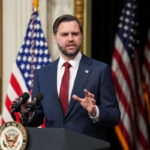
US Vice President Jay Dee Vance returned to his hometown in Ohio, in an electoral move that carries two parallel goals: gathering support for Republican candidates before the midterm elections next November, and strengthening his position early as one of the most prominent names proposed to succeed President Donald Trump in the 2028 elections.
Vance chose Middletown, where he grew up, to deliver a speech inside the Cleveland-Cliffs Middletown Works steel plant, the same factory where his grandfather worked for nearly 40 years, recalling the story of his family’s rise from the working class and linking it to the economic message that Republicans are trying to send to industrial “Rust Belt” voters.
Speaking about his grandfather, Vance said that he worked in the same place as a welding technician for decades, before his grandson today became Vice President of the United States, in a scene he was keen to present as a reflection of what he calls “the American dream.”
Middletown was strongly present in Vance’s famous book “Hillbilly Elegy,” which was published in 2016, in which he recounted the details of his upbringing in a working-class family in an area that suffered from the decline of traditional industries and social and economic crises.
This background forms an essential part of the political identity on which Vance built his rise from writer and lawyer to senator, then vice president, and it also gives him direct access to a popular base that played a pivotal role in the rise of the Trump movement within the Republican Party.
In his speech, Vance focused on the economic situation, costs of living, and the future of industrial jobs, considering that the Trump administration is working to reverse decades of industrial decline, and defended trade policies, immigration, and tariffs as tools to protect American jobs. At the same time, he said that the administration has “a lot of work to do” and that addressing the economic challenges will not happen overnight.
The tour comes at a time when Vance is becoming one of the most prominent Republican figures that the party relies on to mobilize voters before the midterm elections, amid strong competition for control of Congress.
In Ohio in particular, Republicans are fighting sensitive electoral races, most notably the attempt by Senator Jon Husted, who was appointed to succeed Vance in the Senate, to retain the seat against former Democratic Senator Sherrod Brown, in addition to the state governor’s race, which is being run by Republican Vivek Ramaswamy. Husted and Ramaswamy participated in the event during which Vance spoke.
It is expected that the Vice President will expand his electoral movements during the coming period through more gatherings, fundraising events, and visits to states witnessing strong competition, in an indication of the role he will play in trying to protect the Republican majority during the November elections.
But the moves are not only read from the perspective of the 2026 elections, as speculation is increasing within American political circles regarding Vance’s presidential ambitions in 2028.
Vance has not officially announced his candidacy for the presidency, but his position as Trump’s deputy and his close relationship with the conservative Republican base made him one of the first names proposed to lead the party in the post-Trump era.
The midterm elections gain additional importance for him, as their results may become a test of Vance’s ability to mobilize the party’s base, raise money, and support Republican candidates, factors that will be influential if he decides to enter the presidential primaries later.
Under the 22nd Amendment to the US Constitution, no person can be elected to the office of president more than twice, which prevents Trump, who was elected in 2016 and 2024, from winning a third elected presidential term, and effectively places the 2028 race before a new stage within the Republican Party.
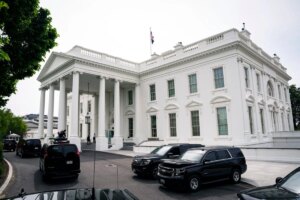
However, the road ahead for Vance does not appear to be free of competition, as US Secretary of State Marco Rubio, a former senator from Florida, stands out as one of the most prominent names proposed in the Republican calculations for the upcoming elections. The official White House website confirms that Rubio currently holds the position of US Secretary of State.
Rubio had expressed in previous statements his openness to supporting Vance if the latter decided to run in the race, but early opinion polls indicate that the competition within the Republican camp is still subject to change two years before the elections.
A national poll conducted by Emerson College on August 16 and 17 showed that Rubio is performing better than Vance in a number of hypothetical confrontations against the most prominent potential Democratic candidates in 2028.
According to the poll, Pete Buttigieg maintained a 5-point lead whether against Vance or Rubio, while the lead of Jon Ossoff and Gavin Newsom decreased when the confrontation was with Rubio instead of Vance. Kamala Harris also led Vance by 4 points, while she trailed Rubio by 5 points. The poll included 1,000 voters likely to participate in the elections, with a margin of error of approximately 3 points.
As for Vance, during his current movements he is trying to emphasize his connection to the working class and his position within the political and economic project of the Trump administration, while adopting language that evokes his personal roots more than its direct focus on his presidential ambitions.
His speech was not without a sharp attack on Democrats, as he accused the party of turning away from the working class, which had historically constituted a core part of its base, and urged Republicans to participate massively in the November elections.
This makes his return to Middletown more than just a local campaign stop, as the city that was the starting point of his personal and political story has become a platform from which he re-introduces himself to American voters, while the Republican Party gradually approaches the bigger question: Who will inherit the leadership of the political movement that Trump built when the battle for the White House in 2028 actually begins?