Translation of “Lebanon Debate”
The data that followed the raids on Abu Al-Duhur military airport in the eastern countryside of Idlib revealed that the goal was not linked to Iran or Hezbollah, but rather to prevent a Turkish military concentration and thwart attempts to rebuild Syrian air capabilities.
According to a report by journalist Tal Be’eri at the Israeli “Alma” Center, the raids targeted the airport runway and a number of warehouses, causing material damage but no casualties. The Center believed that the attack on the runway aimed to temporarily disrupt its use, while the warehouses may have contained advanced equipment or weapons.
The identity of the planes was unknown immediately after the attack, before the office of Israeli Prime Minister Benjamin Netanyahu announced Israel’s responsibility for it, stressing that Syria was “on the verge of violating the existing security situation” by allowing Turkish forces to deploy at an air base near Aleppo.
Israel said that it had repeatedly warned Damascus that such a Turkish deployment would pose a threat to its security, but the Syrian authorities ignored the warnings. Tel Aviv also informed the US administration in advance of the operation, according to American and Israeli officials who spoke to Axios.
The Israeli story intersected with reports that a Turkish military delegation recently visited Abu Al-Duhur Airport to inspect its rehabilitation plans. The Syrian Observatory for Human Rights also spoke of a Turkish contribution to the restoration of the base, in parallel with moves to rebuild the Syrian air defense system and install radar systems.
The raids came days after the Syrian Air Force carried out training exercises in the airspace of Aleppo and Idlib, amid Israeli reports of Damascus accelerating the recruitment of pilots and restarting fighters and helicopters. Israel fears that the deployment of advanced Turkish air defenses, such as the “Hissar” system, will restrict the freedom of its air force’s operations in Syrian airspace.
Israel had targeted the “T4” base in April 2025, after Turkish plans emerged to establish military capabilities and air defenses there. ACLED, an organization specialized in monitoring conflicts, believes that targeting Abu al-Duhur repeats the same scenario and sends a direct warning to Ankara.
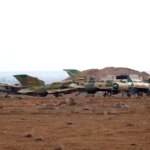
The airport is located about 45 kilometers east of the city of Idlib and about 70 kilometers from the Turkish border. It was considered one of the largest air bases in northern Syria, as it hosted MiG-21 and MiG-23 aircraft and helicopters during the reign of Bashar al-Assad, before it was subjected to widespread destruction during the war.
Al-Nusra Front fighters took control of the base in September 2015, then Assad’s army regained it with Russian support in January 2018. On November 30, 2024, it returned to the control of the opposition forces, before moving to the Ministry of Defense and the new Syrian army after Ahmed Al-Sharaa took power.
Damascus condemned the raids and described them as “unjustified aggression,” while Türkiye accused Israel of targeting the Syrian military structure and violating the country’s sovereignty. US envoy Thomas Barrack also considered that the attack constituted “an unnecessary escalation that does not enhance regional stability.”
Accordingly, the strike reveals that Israel has drawn a clear red line: no Turkish bases, no advanced air defenses, and no rebuilding of the Syrian air force, which might threaten its superiority and freedom of movement. As for Abu al-Duhur, he was the arena for sending the message to both Damascus and Ankara.