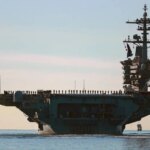
US President Donald Trump downplayed reports of the deteriorating living and psychological conditions of the crew of the aircraft carrier USS Abraham Lincoln, after a deployment that lasted 266 days, including 200 days in areas of direct combat, stressing that it will leave the area of operations soon and be replaced by another carrier.
In response to reports of the sailors’ families being concerned, Trump said: “No, they are not worried.” He also rejected criticism regarding the carrier remaining at sea for 9 months, considering this period “not sufficient.”
He confirmed that another carrier would replace the “Abraham Lincoln,” in light of the continuing confrontation with Iran over the Strait of Hormuz and the nuclear program, saying: “That ship is moving now or will move very soon, and it will be replaced by another similar carrier.”
The United States had announced its readiness to send the aircraft carrier USS George Washington to the Middle East, as part of a scheduled rotation with the Abraham Lincoln.
In turn, Acting US Navy Secretary Hong Kao announced that the carrier had completed its mission successfully and would return to the United States soon, explaining that the extension of its deployment was imposed by field requirements and the difficulty of combat operations.
According to the Navy statement, the carrier’s air groups carried out more than 10,000 sorties and dropped about 1.5 million pounds of munitions. The carrier also recorded the highest personnel retention rates compared to other aircraft carriers, while a limited number of mental health cases were dealt with without any deaths recorded.
The statement acknowledged the imposition of restrictions on telephone communications between sailors and their families during periods of high threat levels, stressing that the forces “were pushed to the maximum limits of endurance and work pressure,” and that they suffered natural fatigue, but “they did not break down and remained in the heart of the battle.”
On the other hand, reports of food shortages, broken sanitation systems, and worsening mental health crises raised concerns from Democratic members of Congress, after the carrier recorded the longest deployment mission in its history.
Senator Richard Blumenthal called on the Navy to clarify the conditions on board the ship, which spent more than 250 days on a deployment mission, including more than 200 continuous days without docking, setting a record for the number of consecutive days at sea.
The US Navy leadership also faced the anger of the families of about 5,000 sailors and Marines, during a meeting at the North Island Naval Air Base in San Diego and a virtual meeting held later.
The families demanded clarifications regarding the deterioration of their children’s mental health and the timing of their return, while some of them spoke of two sailors trying to jump from the ship into the sea. The US Army announced that it had recovered a sailor who fell into the water on August 3.
“Abraham Lincoln” includes 5 priests, a psychologist, a social worker, and a “prevention coordinator,” in addition to a trained dog to provide moral and psychological support to crew members.
In the face of criticism, Hong Kao accused the media of trying to portray the fighters as victims, considering that this constitutes misinformation that diverts attention from the enemy and the threats targeting the United States.
US Secretary of War Pete Hegseth also launched an attack on the media, describing them as “reckless” and deliberately distorting the truth of what happened on board the carrier, stressing that the members of the strike group were proud of their mission and the steadfastness they demonstrated.
The “Abraham Lincoln” departed San Diego on November 21, 2025, as part of a mission to the South China Sea, before being redirected to the Middle East ahead of the US-Israeli attacks on Iran that began on February 28.
Between the US administration’s confirmation of the mission’s success and families’ testimonies of exhaustion and psychological crises, Abraham Lincoln’s 266-day journey reveals part of the hidden human cost of the ongoing confrontation with Iran.