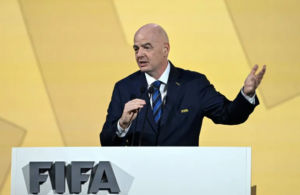
The presidents of the football federations of Lebanon, Qatar, Egypt, Morocco, Sudan and Mauritania announced their full support for FIFA President Gianni Infantino, at a time when he is facing a crisis within FIFA before the presidential elections scheduled for March 2027.
The position came in a joint statement that affirmed confidence in Infantino’s leadership and continued cooperation with him. But the importance of the statement is not limited to the number of signing federations, as four of its presidents are members of the FIFA Council, namely Qatari Hamad bin Khalifa Al Thani, Egyptian Hani Abu Rida, Moroccan Fawzi Lakjaa, and Mauritanian Ahmed Yahya.
The statement was issued after Infantino backed down from a project to establish a commercial entity that would manage the rights to FIFA tournaments, and sell a share of about 20% of it to private investors for approximately $4.2 billion.
The project included each national federation receiving $20 million during the next funding cycle, with the possibility of doubling the amount to $40 million if the plan was approved. However, Infantino withdrew the project after widespread objections, while the European and Asian federations and CONCACAF accused him of not consulting and managing the file unilaterally, and demanded an independent review.
The Arab position practically revealed that the continental federations’ objection does not mean their members are committed to it. Qatar and Lebanon are members of the Asian Confederation, which criticized Infantino’s plan, but they chose to support it separately. The African Union, which includes 54 federations, also announced its support for the FIFA President, although the vote of its members is not guaranteed collectively.
The importance of these positions lies in the FIFA election system, where each national federation has one vote, regardless of its size or football strength. Infantino needs 106 votes if he faces one competitor, while he needs two-thirds of the votes in the first round if more than one candidate presents. The deadline for submitting nominations ends on November 18, before the elections scheduled in Morocco on March 17, 2027.
As for Lebanese support, it is not a new position taken after the crisis. Last May, the Lebanese Federation announced its support for Infantino’s candidacy for a term extending until 2031, and said that cooperation with him was reflected in development projects, training courses, and programs for Lebanese football.
Infantino and his family also obtained Lebanese citizenship last February, after a visit to Beirut during which he discussed the project to establish a new stadium. The President of the Lebanese Federation, Hashem Haider, said at the time that FIFA promised to fund the project through a grant. But there is no information or published evidence linking nationality or the stadium project to the electoral position of the Lebanese Federation.
Direct interests appear in some other federations as well. Morocco is a partner in hosting the 2030 World Cup and seeks to host the final match, while FIFA denied reports that Infantino made promises related to the final in exchange for support. As for Qatar, it has had a long relationship with the leadership of the International Federation since hosting the 2022 World Cup.
Thus, the Arab alignment is linked to three stated factors: benefiting from FIFA’s funding programs, direct relations with Infantino, and preparing for the next presidential battle. But the available facts do not prove the existence of a financial agreement or barter in exchange for votes.
What is certain is that the six federations chose to announce their support for Infantino at a time when other federations, including Ireland, began withdrawing their support due to concerns related to governance and transparency. This makes the Arab statement part of an early electoral mobilization process, rather than a position linked to the already withdrawn trade rights plan.
The position came in a joint statement that affirmed confidence in Infantino’s leadership and continued cooperation with him. But the importance of the statement is not limited to the number of signing federations, as four of its presidents are members of the FIFA Council, namely Qatari Hamad bin Khalifa Al Thani, Egyptian Hani Abu Rida, Moroccan Fawzi Lakjaa, and Mauritanian Ahmed Yahya.
The statement was issued after Infantino backed down from a project to establish a commercial entity that would manage the rights to FIFA tournaments, and sell a share of about 20% of it to private investors for approximately $4.2 billion.
The project included each national federation receiving $20 million during the next funding cycle, with the possibility of doubling the amount to $40 million if the plan was approved. However, Infantino withdrew the project after widespread objections, while the European and Asian federations and CONCACAF accused him of not consulting and managing the file unilaterally, and demanded an independent review.
The Arab position practically revealed that the continental federations’ objection does not mean their members are committed to it. Qatar and Lebanon are members of the Asian Confederation, which criticized Infantino’s plan, but they chose to support it separately. The African Union, which includes 54 federations, also announced its support for the FIFA President, although the vote of its members is not guaranteed collectively.
The importance of these positions lies in the FIFA election system, where each national federation has one vote, regardless of its size or football strength. Infantino needs 106 votes if he faces one competitor, while he needs two-thirds of the votes in the first round if more than one candidate presents. The deadline for submitting nominations ends on November 18, before the elections scheduled in Morocco on March 17, 2027.
As for Lebanese support, it is not a new position taken after the crisis. Last May, the Lebanese Federation announced its support for Infantino’s candidacy for a term extending until 2031, and said that cooperation with him was reflected in development projects, training courses, and programs for Lebanese football.
Infantino and his family also obtained Lebanese citizenship last February, after a visit to Beirut during which he discussed the project to establish a new stadium. The President of the Lebanese Federation, Hashem Haider, said at the time that FIFA promised to fund the project through a grant. But there is no information or published evidence linking nationality or the stadium project to the electoral position of the Lebanese Federation.
Direct interests appear in some other federations as well. Morocco is a partner in hosting the 2030 World Cup and seeks to host the final match, while FIFA denied reports that Infantino made promises related to the final in exchange for support. As for Qatar, it has had a long relationship with the leadership of the International Federation since hosting the 2022 World Cup.
Thus, the Arab alignment is linked to three stated factors: benefiting from FIFA’s funding programs, direct relations with Infantino, and preparing for the next presidential battle. But the available facts do not prove the existence of a financial agreement or barter in exchange for votes.
What is certain is that the six federations chose to announce their support for Infantino at a time when other federations, including Ireland, began withdrawing their support due to concerns related to governance and transparency. This makes the Arab statement part of an early electoral mobilization process, rather than a position linked to the already withdrawn trade rights plan.