October 22, 2026

An unprecedented political and judicial crisis in Lebanon: The authority is heading towards a comprehensive confrontation with Hezbollah, and the latter warns of an “explosion”
Beirut – “Lebanon Debate” (Abdullah Qamh)
The Lebanese political arena is witnessing a sharp escalation that threatens an internal explosion, amid Hezbollah’s firm conviction that the official authority is seeking to drag it into an open confrontation through a judicial and political path aimed at imposing a change in the function of its weapons. According to the data, the cost of silence for the party has become much higher than the cost of confrontation, which prompted it to declare its readiness to reject attempts to isolate and encircle it.
Despite the intense efforts led by mediators – which included efforts by the Qatari Prime Minister during his recent visit to Beirut to push for calm and foster a dialogue between Baabda Palace and the southern suburb, in addition to attempts to prevent the inclusion of the item of referring the Dahr al-Baydar shipment file to the Judicial Council on the agenda of the Council of Ministers – these efforts failed, and the security coordination channel between the party and the official agencies collapsed after a request from the President of the Republic to stop it.
Official sources indicate that the inclusion of the referral clause to the Judicial Council comes as a confirmation of an approach adopted by the President of the Republic, Joseph Aoun, and in implementation of security and political commitments towards the United States. These trends crystallized following a phone call between President Aoun and US Secretary of State Marco Rubio, and with close follow-up by the US Ambassador to Beirut, Michel Issa.
This political tension was preceded by rapid field escalation. The incident of the Indian medicine warehouse in “Galerie Semaan”, the report of which was issued by the Minister of Health, Rakan Nasser al-Din, who is affiliated with the party, was used to show the presence of the security authority, after receiving prior information about a possible raid on centers affiliated with the party. The party’s response came through field movements that included a night tour of about 100 motorcycles in Beirut and its environs, which the authority monitored via a direct message. It responded by strengthening the deployment of the Lebanese army in the southern suburb and the vicinity of the airport, and holding an emergency security meeting at Baabda Palace, during which the party’s security deployment took place in full view of the army units.
In a move considered a strategic shift, MP Hassan Fadlallah provided public political cover for the Dahr al-Baydar weapons shipment and identified those responsible for it, moving the party from the logic of acquiescence to declared political sponsorship of military steps. This position was exploited by President Joseph Aoun to hold a meeting of the leaders of the security services in Baabda, which provided political cover for the actions of Minister of Justice Adel Nassar regarding the referral to the Judicial Council, and launched a sharp attack on MP Fadlallah, accusing him of defying the state.
The meeting established a new approach that deals with Hezbollah as a single integrated bloc (politically, security-wise, and militarily), going beyond the government’s decision issued on March 2, which paves the way for a broader path of accountability that may lead, according to political readings, to a project to dismantle and dissolve the party. President Aoun also requested that military and security files be coordinated with the government commissioner to the military court, Judge Claude Ghanem, in light of American support for his role, while he restricted the criminal and political files to the Cassation Prosecutor, Judge Ahmed Rami Al-Hajj.
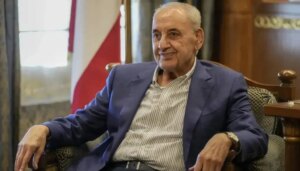
In light of this heated climate, the tone of warnings has increased from prominent leaders. Speaker of the House of Representatives, Nabih Berri, said, “Whoever makes the mistake of believing that the country is in chaos is delusional, as the country has not escaped yet,” while Representative Ibrahim al-Moussawi warned that external dictates might lead to an explosion, and Representative Hussein al-Hajj Hassan raised the ceiling by saying: “We have reached the ceiling, and we are warning the authority not to go too far!” Diplomats accredited in Beirut also reflected serious fears of internal discord and division that might translate into the street.
In light of these developments, the question is no longer limited to whether the government will proceed with referring the file to the Judicial Council or not, but rather is linked to the nature of Hezbollah’s response. Whether it will be limited to a political response or will it move toward escalatory options that include withdrawing from official councils and taking to the squares.