October 10, 2026

The Ministry of Agriculture, represented by the Directorate of Rural Development and Natural Resources, announced the completion of an air control campaign targeting the insect “Leptoglossus sp,” which causes severe damage to the cobs and seeds of fruit-bearing pine forests, which has a negative impact on the productivity and economic returns of this vital sector.
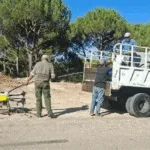
The campaign was carried out between August 26 and September 30, 2026, using drones specialized in agricultural spraying that were put into service as a gift from the People’s Republic of China, in a step that reflects the Ministry’s direction towards adopting modern technology and integrated forest pest management.
The spraying operations covered a total area of 1,437 hectares of fruitful pine forests, distributed geographically over four districts as follows: Baabda District, with an area of 680 hectares, Aley District, with 350 hectares, Chouf District, with 327 hectares, and Jezzine District, with 80 hectares.
The Ministry explained that the adoption of drones represents a qualitative development in pest control. It allows determining intervention areas with high accuracy, controlling the quantities of pesticides and distributing them rationally, as well as the ability to reach rugged areas and reducing operational costs compared to traditional helicopters. The technology also contributes to documenting the treated areas and improving monitoring and evaluation according to a scientific approach based on accurate diagnosis, determining the timing of intervention according to climatic and technical conditions, and field monitoring of infection levels and control results.
In terms of challenges, the Ministry indicated that spraying operations stopped at the end of last September due to rainfall and changing weather conditions, pointing out that Israeli electronic interference in the southern regions constituted an additional obstacle that affected the navigation and positioning systems of drones, which limited the accuracy of operations and the safety of their implementation. In this context, she stressed the continued evaluation of the technical, climatic and security conditions to resume interventions as soon as appropriate conditions are available.
The Ministry of Agriculture stressed that protecting fruit-bearing pine trees constitutes an environmental, economic and social priority, given the role of this sector in supporting the rural economy and providing sources of income for families working in its production and marketing, in addition to the vital role of forests in protecting soil, preserving biodiversity, and enhancing the ability to adapt to climate change.
At the conclusion of its statement, the Ministry called on municipalities and municipal unions to enhance cooperation with agricultural departments and early report any forest infections to ensure preventive intervention and limit the spread of pests. She stressed that the criterion for the success of control is not limited to treated areas only, but extends to include reduced infection levels, improved tree health, and restoration of their productivity, stressing her commitment to continuing to modernize the forest protection system through technology, scientific monitoring, and sustainable management to protect forest wealth, national production, and the livelihoods of rural communities.