“Lebanon Debate”
Every time Iran is subjected to an American strike, attention automatically turns to the bases spread across the Gulf. But Tehran has recently begun to change the map of its responses, reducing direct pressure on the Gulf states and pushing Jordan to the forefront of the targeted arenas.
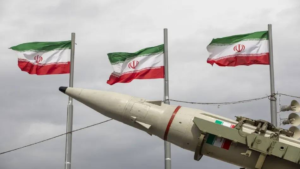
This transformation was clearly evident when the Revolutionary Guard launched 20 ballistic missiles towards Jordanian territory, according to the official number announced by the Jordanian army. The defenses were able to intercept 18 missiles, while two landed in areas far from population centers, without causing any casualties.
The attack came after the US Central Command announced the destruction of 5 Iranian oil tankers, in response to two attempts to target an American warship with ballistic missiles. The Revolutionary Guard said that the missiles it fired were targeting an American base inside Jordan.
But Jordan’s choice does not appear to be linked solely to the presence of American forces on its territory. American bases are also spread out in Qatar, Bahrain, Kuwait, the Emirates, and Saudi Arabia, and some of them are geographically closer to Iran and easier to target than Jordanian territory.
A reading published by Israeli Channel 14 proposes an explanation based on the fact that Tehran is trying to restore its relations with the Gulf states and avoid reunifying them behind the United States. Iran, despite previous tensions and threats, needs to keep political and economic channels open with its Gulf neighbors, especially under the pressure of war, sanctions, and restrictions imposed on its oil exports.
As for Jordan, it does not occupy the same position in Iranian calculations. The relationship between the two countries has remained cold and tense, and Tehran views the Kingdom as part of the American security structure in the region and a partner with Israel in intercepting Iranian drones and missiles.
Choosing a distant target also carries a military message. By launching missiles that cross a long distance towards Jordan, the Revolutionary Guard is trying to show that its capabilities are still capable of reaching distant targets, despite the strikes on its military systems.
But this option has significant risks. Jordan is not just an arena for American bases, but rather a country located between Iraq, Syria, Israel and Saudi Arabia. Any error in the trajectory of the missiles or interception operations could open an additional front or lead to casualties within the Kingdom or in neighboring countries.
The passage of missiles in close proximity to Israel pushes its defense systems into a state of alert, and gives it an additional justification to intervene or carry out pre-emptive strikes against Iran.
Thus, it seems that Tehran is trying to implement a precise equation: attacking the United States without antagonizing the entire Gulf, showing the range of its missiles without directly targeting Israel, and using Jordan as a calculated pressure arena.
However, missiles do not always acknowledge political calculations. What Iran considers a controlled response may turn, with one missile landing in the wrong place, into a war whose borders do not remain within Jordan.