The University of Benghazi has returned to work with all its faculties and facilities, after the completion of a comprehensive project for its reconstruction and rehabilitation carried out by the Libya Development and Reconstruction Fund, headed by its Director General, Engineer Belkacem Khalifa Haftar, so that the university regains its activity on its main campus more than 11 years after its closure.
One of the most prominent features of the new university city is the remarkable presence of sports as an essential part of academic life, as the university includes 10 stadiums and sports facilities completed according to international specifications and Olympic and international standards, allowing for hosting sporting activities and tournaments, providing Libyan and foreign students with an integrated environment to discover and develop talents, and opening up broader horizons for them to build a sporting future in parallel with their academic career.
This aspect gains additional importance in a university that includes nearly 100,000 male and female students, as the new sports facilities constitute a space capable of embracing thousands of young people, attracting university talents and working to develop them, thus enhancing the university’s role not only as an institution for education and scientific research, but also as an incubator for youth and sports energies in Libya.
Engineer Belkacem Khalifa Haftar followed the finest details of the project, which began for him as a personal dream before it turned, in just 3 years, into a comprehensive reconstruction process that rebuilt an integrated university city, which includes colleges, laboratories, the central library, academic and administrative buildings, roads and infrastructure, in addition to modern student hostels with an advanced level of residence, thus enhancing the university’s ability to receive students from various parts of Libya and the world.

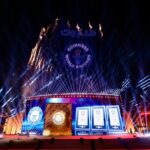
The opening ceremony was the size of the project, in an exceptional show that combined technology, art, and narrated the history of the University of Benghazi, through 3D mapping techniques and advanced visual and production effects, on an amphitheater that can accommodate more than 15,000 viewers.
The ceremony witnessed a wide Libyan and international presence, presented by Commander Khalifa Haftar and Engineer Belkacem Khalifa Haftar, along with Libyan figures and graduates from various generations of the university, a large number of ambassadors and representatives of foreign companies and international delegations, as well as about 240 foreign guests who came from a number of countries to participate in the event.

The ceremony was also marked by advanced air shows carried out by squadrons of drones within an integrated electronic system, and culminated in the achievement of 3 world records documented in the Guinness Book of World Records, represented by the formation of an image of an eagle, and the formation of a feather that wrote the name “University of Benghazi” in the sky, in addition to the formation of the symbol of peace, within visual paintings that carried connotations related to the identity of the university and its scientific and humanitarian mission.
Investment in education is not limited to the University of Benghazi, as reconstruction and rehabilitation projects included universities and educational institutions in Kufra, Al-Bayda, Derna, Al-Marj, Ajdabiya, Sirte, Brak Al-Shati, and Murzuq, in addition to the restoration and rehabilitation of about 250 schools in various Libyan regions.
With the opening of the University of Benghazi, Libya will regain one of its ancient academic edifices, and with it will regain a university city for life, science and sports, opening up to new generations of Libyan and international students the opportunity to combine academic excellence with athletic ambition, and providing young talents with an infrastructure capable of transforming talent into achievement.