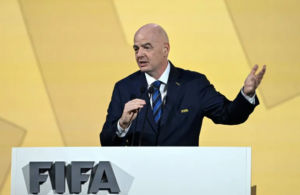
According to Reuters, the federations of Europe, UEFA, Asia, AFC, and CONCACAF, which represents North and Central America and the Caribbean, are discussing this option, in an unprecedented step in FIFA’s 122-year history.
An informed source said that “there is no way out” of the crisis, adding that Infantino will either choose to leave quietly and not run next March, or he will face the more difficult path through a possible vote of no confidence.
The FIFA regulations do not include a specific text regulating the no-confidence vote against the president, but they allow the Federation Council to call for an extraordinary conference at any time, and they also oblige it to do so if one-fifth of the 211 member federations requests the inclusion of a specific item on the agenda.
The crisis erupted after Infantino proposed to sell a minority stake in a new commercial entity affiliated with FIFA to private investors, with this entity taking over the management of the commercial rights to the World Cup, the most important event in football. FIFA says that revenues for the 2023-2026 tournament are expected to exceed $15 billion, most of which will come from the 2026 World Cup year.
The three major federations strongly opposed the proposal, considering that the way it was dealt with revealed a defect in transparency, consultation and governance. The crisis deepened this week with the departure of FIFA Director of Operations Kevin Lamour, after he criticized the plan and said that employees had been “deceived” in a project that he described as a one-person project.
FIFA Vice President Shandor Chani also withdrew his support for Infantino, considering that Lamour’s departure was “the last straw.”
Despite this, Infantino still has broad support within a number of member associations, especially in Africa. African Union President Patrice Motsepe said that Infantino’s future must be decided through elections, stressing continued African support for him.
Six Arab federations, including Qatar and Morocco, announced their public support for Infantino last week, while FIFA’s leadership confirmed its full support for him after a crisis meeting in Morocco.
Infantino’s opponents fear that a failed vote of no confidence will strengthen him, because it will demonstrate his continued electoral support before the presidential elections scheduled for March 2027.
The difficulty of the confrontation is increased by the absence of any declared competitor so far before the nomination deadline on November 18. Some federations also want to know the alternative and its program before entering into an open battle with the FIFA president.
The pressure is not limited to unions that have the right to vote. The European Club Foundation, which is headed by Paris Saint-Germain President Nasser Al-Khelaifi and represents more than 800 clubs, stands with those calling for a change in the way FIFA is run, and has warned that clubs may refuse to participate in future editions of the Club World Cup for men and women if their concerns about governance and the relationship with the International Federation are not addressed.
Although the clubs do not have votes within FIFA, they have great sporting and commercial weight, which makes their position an additional pressing factor.
Experts believe that Infantino’s electoral victory, even if achieved, will not end the crisis if the federations and major clubs are against him. The problem is no longer just the number of votes, but rather the ability of the FIFA president to manage the organization while the most influential football powers stand against him.
The bottom line is that the Infantino crisis has gone beyond the proposal to invest in the World Cup. What is happening is a struggle over who owns the decision-making process in world football: the FIFA president, who is supported by a wide network of federations, or the continental federations and major clubs who see that trust has been damaged and is no longer easy to restore.