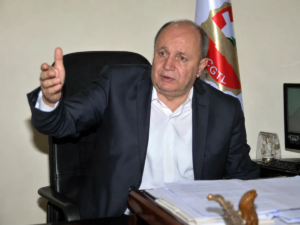
Representative Hassan Ezz El-Din considered that Ali Al-Taher Heights is not the basis of the current confrontation, but rather part of a broader battle linked to what is happening in the south and Lebanon, stressing that the site is considered one of the basic sites of the resistance and that it “will not abandon it.”
Ezz El-Din said, in an interview with Sputnik Radio, that the resistance “will confront any aggressive action with all its capabilities and abilities, and will carry out its national duty if Israel attacks this site,” adding that “if help comes from Iran, that will be a light upon light.”
He pointed out that Iran, through what he described as its “stability and steadfastness,” is sending a message of strength at the regional level, considering that it has established an equation related to the southern suburb of Beirut, and may be heading to draw a “new equation” related to Ali Al-Taher.
In a remarkable position on the political track, Ezz El-Din saw that “the framework agreement will be of no use,” considering that it was “born dead, worth nothing, and represents a violation of sovereignty,” noting that the street’s anger “is present, existing, and ongoing,” but that its movement, as he put it, “is waiting for the appropriate time and circumstance.”
Ezzedine attacked the political authority, accusing it of not giving the Lebanese army the necessary political decision to confront Israel, and of not providing the armament and capabilities required for it, describing the authority as “failing, conspiring, and lacking in will, independent national decision-making, and all elements of power.”
In response to a question about the possibility of expanding the confrontation, he stressed that decision-makers, in the logic of wars, place before them various scenarios and possibilities, considering that the resistance must remain “fully prepared for all possibilities.”
He also saw that Israeli Prime Minister Benjamin Netanyahu has become, as he put it, “a prisoner of achieving an achievement through which he is marketing his campaign,” considering that he seeks to control Ali Al-Taher Hill “no matter the cost.”
Ezz El-Din stressed that the resistance “will resist and will not raise the white flag under any circumstances,” noting that the field reality is what will determine the nature and course of the battle.
Ezz El-Din’s statements come in light of the increased focus on Ali Al-Taher Heights during the recent period, after Israeli reports spoke of the region’s military importance and the presence of underground infrastructure there, while Israeli estimates linked the fate of the site to the possibility of an expansion of the confrontation with Hezbollah and attempts to bring Iran into the line of the file.
Israeli reports had claimed that Hezbollah is seeking Iranian support in the Ali Al-Taher file, at a time when field tension continues in the south, in parallel with a political discussion about the framework agreement, its implementation mechanisms, and the deployment of the Lebanese army in the areas covered by it.
Regarding the relationship between Hezbollah and Syrian President Ahmed al-Sharaa, Izz al-Din revealed that Turkey “holds the initiative,” saying that after knowing its content, “we will build on what it requires,” indicating that there is a positive atmosphere in the relationship between Hezbollah and the Turkish side.
He considered that US President Donald Trump’s threat to use the card of Syrian President Ahmed al-Sharaa constitutes, as he described it, “mere intimidation and pressure,” stressing that Hezbollah’s position on Syria is clear.
Ezzedine concluded by pointing out that the convergence of the will of the two parties, the appreciation of the two leaderships, and the political circumstances may open the door to a meeting between Hezbollah and the Syrian side.