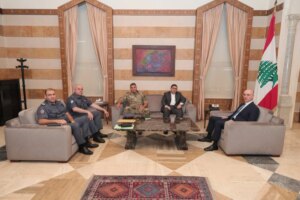
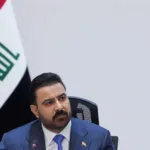
President Joseph Aoun saluted the parliamentary initiative and petition demanding the extension of UNIFIL forces in southern Lebanon, stressing that the first Lebanese option is to continue the international force’s mission, and if that is not possible, to move to another formula that guarantees the presence of international forces alongside the Lebanese army.
President Aoun stressed the importance of UNIFIL’s presence in the south in several aspects, especially its role in promoting stability and helping residents remain in their villages and towns, in cooperation and coordination with the Lebanese Army.
He said: “Our first option is to extend UNIFIL forces, and if it is not extended, the second option is to adopt a formula that guarantees the continued presence of international forces in the south, within the required legal framework.”
He stressed that any alternative formula must ensure the presence of international forces alongside the Lebanese army and in coordination with it, in a way that supports stability and helps in implementing the tasks assigned to them.
President Aoun revealed that Israel rejects the continued presence of UNIFIL forces and has been pressing in this direction for nearly a year, in exchange for Lebanon’s insistence on their presence, which places the future of the international presence in the south at the heart of the ongoing diplomatic confrontation.
He explained that the basic idea for Lebanon is to create a breach that ensures the continued international presence in the south, whether through an extension of UNIFIL or through a supporting international force, in a way that maintains stability and strengthens the role of the state and the Lebanese army.
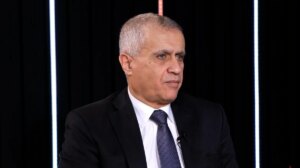
President Aoun’s position comes in conjunction with a broad parliamentary movement to demand the extension of the international force, led by a group of representatives led by MP Melhem Khalaf, amid fears of the repercussions that any international vacuum might leave in the south in light of the delicate military and security conditions that the region is going through.
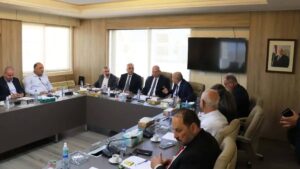
Khalaf had announced that the petition demanding the extension had the signatures of 86 deputies, while a delegation including 20 deputies from various orientations and blocs visited the President of the Republic, in an attempt to strengthen the Lebanese position towards maintaining the international presence.
The move acquires additional importance in light of President Aoun’s confirmation that there has been continuous Israeli pressure for nearly a year to end the presence of UNIFIL, which makes the battle over the future of the international force go beyond the technical discussion about extending its mission to a diplomatic confrontation related to the form of the upcoming security arrangements in southern Lebanon.
UNIFIL has been deployed in southern Lebanon since 1978, while its missions and number expanded significantly after the July 2006 war and the issuance of Resolution 1701 by the Security Council, to work in coordination with the Lebanese army in the southern Litani region.
Since then, the presence of the international force has been an essential element in the mechanism associated with the implementation of Resolution 1701, including monitoring the field situation and the Blue Line, helping to stabilize stability, and coordinating with the Lebanese army.
The sensitivity of the discussion about the future of UNIFIL is increasing in light of the ongoing Israeli military escalation in the south, and the raids, bombings and ground movements that several areas have witnessed during the recent period, in conjunction with efforts aimed at strengthening the army’s deployment and extending state authority.
Hence, President Aoun proposes a Lebanese equation with two options: extending UNIFIL as the first option, or creating an alternative international legal framework that ensures that the south is not left without an international presence working alongside the Lebanese army.
This proposal reflects a proactive Lebanese attempt to avoid any vacuum that might result from the faltering extension, in parallel with parliamentary and official moves towards the concerned countries and the Security Council to maintain an international umbrella in the south.