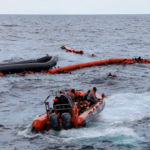
An aerial surveillance operation off the Libyan coast revealed a new tragedy in the Mediterranean Sea, after 11 bodies of migrants were found in advanced stages of decomposition, about 57 nautical miles from the coastal city of Zuwara.
The SOS Mediterranee organization described the scene as “horrific,” explaining that a reconnaissance plane spotted the bodies during a surveillance operation at sea, while some of the bodies were still wearing their clothes, and others were floating with the help of rubber internal tires, according to what was reported by Agence France-Presse.
The organization indicated that the advanced state of decomposition of the bodies indicates that they remained in the water for a period, considering that the scene reflects the scale of the ongoing human tragedy on the migration route across the Mediterranean.
The authorities that carried out the monitoring operation informed the Italian Coast Guard of finding the bodies, while the agency in turn announced that it had notified the Libyan authorities, given their presence within the Libyan search and rescue area.
The Italian Coast Guard explained that the bodies were spotted about 57 nautical miles from the city of Zuwara, which is one of the most prominent coastal points in western Libya, from whose vicinity migrant boats depart towards European coasts.
The spotter plane that discovered the bodies was operated by SOS Mediterranee and the Humanitarian Pilots Initiative, which carry out aerial surveillance operations to monitor migrant boats and distress situations in the Mediterranean.
The incident comes at a time when the Central Mediterranean route is still one of the most dangerous migration routes in the world, as tens of thousands of migrants annually attempt to set off from the coasts of North Africa, especially Libya and Tunisia, to reach the countries of the southern European Union.
A large number of crossing attempts use boats that are not equipped to withstand long sea journeys, and are often overloaded with numbers exceeding their carrying capacity, which raises the risk of sinking or breaking down at sea.
Figures from the International Organization for Migration showed a sharp increase in the known toll of deaths and missing persons on the Central Mediterranean route during the first months of 2026, despite a decrease in the number of people who succeeded in crossing this route.
According to the organization, 821 people died or went missing during the first four months of 2026, an increase of 111% compared to the same period in 2025.
The increase in the number of victims came despite the decline in the number of migrants arriving via the central Mediterranean route by 46% during the same period, bringing their number to 8,577 people.
Comparing the two numbers reveals a remarkable paradox, as the number of crossings decreased while the number of deaths and missing persons increased significantly, which reflects the continuing severe risks associated with this sea route.
The European Border Control Agency (Frontex) also reported that the total number of irregular crossings of the European Union borders decreased to about 178,000 cases, a decline of 26% compared to 2025.
For years, Libya has been a major starting point for migrants coming from various African and Asian countries, taking advantage of its geographical location on the southern coast of the Mediterranean and its relative proximity to Italy and Malta.
The journey between the Libyan and European coasts repeatedly turns into a tragedy, as boats face the dangers of bad sea conditions, shortages of fuel, water and food, technical malfunctions, in addition to delays in rescue operations.
The 11 bodies spotted off Zuwara highlight the ongoing tragedy in the Mediterranean, at a time when European debate continues over migration policies, tightening borders, and search and rescue operations, while the sea remains a witness to thousands of deaths and missing persons on the way to Europe.