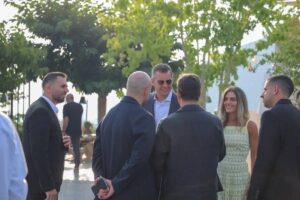
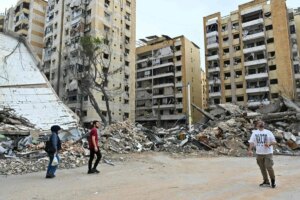
Environment Minister Tamara Al-Zein received a delegation from the municipality of Bint Jbeil, which included the mayor, Mohamed Bazzi, his deputy, lawyer Ziad Baydoun, and a number of members of the municipal council, as part of the ministry’s follow-up of the environmental repercussions resulting from the attacks and destruction that affected the southern regions.
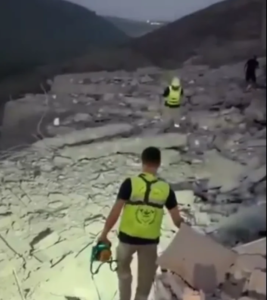
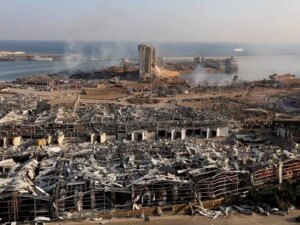
The meeting focused on the reality of the city of Bint Jbeil and the extent of the unprecedented damage inflicted on various sectors, while the delegation handed Minister Al-Zein a detailed documentary report entitled “Bint Jbeil: Memory of Crime,” which addresses the extent of the destruction and its effects.
The delegation stressed that the report constitutes an essential step in preserving the city’s memory and identifying the losses it has suffered, not only on the urban level, but also on the environmental, social, cultural and economic levels.
Al-Zein appreciated the initiative of the Bint Jbeil Municipality and its efforts to complete documentation at the local level, based on the work done by the Ministry of Environment in documenting the environmental damage resulting from attacks.
She pointed out that this path was not spur of the moment, explaining that since she assumed the position of the General Secretariat of the National Council for Scientific Research, she was one of the first to highlight that what Israel is doing falls within what is known as “environmental genocide” and “urban annihilation.”
She pointed out that this approach was translated through a series of reports and studies, most notably the comprehensive report on the impact of the Israeli attacks in December 2024, which was followed by the joint report with the World Bank in March 2025.
Al-Zein announced that the Ministry of Environment launched a specialized report in April 2026 on environmental damage and environmental recovery needs, after completing the necessary scientific analyzes that included soil, land, marine and air systems, in a step that she said was accomplished for the first time with this level of comprehensiveness and specialization in the Ministry.
She stressed that environmental crimes have been a clear feature of the Israeli methodology since October 2023, and were subsequently accompanied by the systematic destruction of homes and urban areas, and the targeting of cultural identity, education, and basic necessities of life.
She stressed that the reconstruction approach cannot be limited to rebuilding buildings and infrastructure, but must be based on an integrated concept of recovery that includes urban, economic, social, cultural and environmental aspects.
She said that she has been working since the first day of her tenure at the Ministry of Environment to consolidate the concept of environmental recovery as an integral part of reconstruction, and to include it at the heart of the discussion with international bodies and donors, as it is a basic condition for rebuilding the affected areas in a sustainable manner.
In this context, she indicated that, with the support of the Finance and Budget Committee in the House of Representatives, she was able to include a financial contribution, albeit a modest one, within the budget of the Ministry of Environment, allowing the implementation of environmental interventions in a number of the most affected towns, wherever security and field conditions permit access.
She considered that this step, despite the limited capabilities, constitutes the beginning of a practical path to environmental recovery on Earth.
Al-Zein stressed the need to generalize Bint Jbeil’s experience in documentation to the various affected towns, so that it becomes part of a national system that preserves evidence, documents the damage, and supports the path of recovery and reconstruction.
She emphasized that documentation is not reduced to numbers and tables, but rather represents the preservation of truth and collective memory.
She concluded by saying that the memory of war is not a luxury or a mere narration of the past, but rather part of protecting belonging and adherence to the land, noting that documenting what happened to Bint Jbeil and other southern towns is a documentation of what happened to people, place, environment and identity, and a condition for reconstruction that is based on the truth and preserves what can be restored and protects what must be protected, and enshrines the right of southerners to their land and their future on it.