November 6, 2026

A wave of sharp decline swept global stock markets, and its repercussions extended from Wall Street to Asian and European markets, following growing concerns about the future of huge investments in the artificial intelligence sector and data centers, amid questions about the ability of companies to reap financial returns commensurate with the hundreds of billions of dollars spent on these projects.
According to the Euronews network, companies listed in the Standard & Poor’s 500 index incurred market losses amounting to about $2.9 trillion during Thursday’s session alone, before the widespread selling wave that affected technology and semiconductor companies extended to Asian markets with the start of Friday’s trading.
This decline came in the wake of the results of the US midterm elections, which resulted in Democrats taking control of Congress, which reignited fears of imposing stricter regulatory restrictions on the establishment of data centers, in response to calls made by Democratic candidates to slow down or stop the expansion of these facilities. These possibilities have cast a shadow of concern among investors about high borrowing costs and the extent of companies’ ability to recover their investments, as well as its repercussions on future demand for electronic chips and electricity and economic growth expectations in the United States.
On Wall Street, the Philadelphia Semiconductor Index recorded its worst daily performance since 2020, declining by 12.2% during Thursday’s session, bringing its weekly losses to about 16%. In the same context, the Nasdaq Composite Index fell by 5.5%, the Standard & Poor’s 500 Index fell by 4.4%, while the Dow Jones Industrial Average lost 3.4%, recording the largest daily losses since US President Donald Trump announced the imposition of broad customs duties in April 2025. The Nasdaq Index ended its trading 11.9% lower than its record level, approaching the price correction zone.
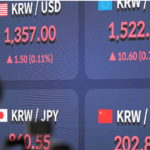
In Asia, markets were severely affected by these concerns; In Japan, the Nikkei 225 index fell by 5.7% at midday after falling by about 7%, recording losses of more than 10% for the shares of “Kioxia” and “Softbank,” and more than 8% for the shares of “Advantest.” In South Korea, the KOSPI index fell by 8.8%, prompting the authorities to suspend trading for 20 minutes, with shares of “SK Hynix” declining by about 10% and “Samsung Electronics” by about 8%.
As for Taiwan, the TAEX index closed down by 4.5%, affected by the losses of the chip manufacturer TSMC, which amounted to 8.5%. The losses extended to include the Hang Seng Index in Hong Kong by 0.7%, the Shanghai Composite Index by 1.3%, and the Australian S&P/ASX 200 Index by 1%. Commenting on this, Neil Wilson of Saxo Markets considered that the selling wave seemed exaggerated, stressing that investors are awaiting market stability before resuming buying.
On the political level, US President Donald Trump held the Democrats responsible for the collapse, indicating on his “Truth Social” platform that the stock market collapsed as a result of their victory in Tuesday’s elections, and stressing that they must bear full responsibility.
In other global markets, futures contracts for the European Euro Stoxx 50 index fell by about 1% before the opening of trading. In commodity and currency markets, Brent crude futures rose by 1.4% to settle below $100 per barrel, supported by a previous decline following hopes for an end to the war with Iran. On the other hand, the dollar rose against the euro and the yen, while spot gold fell by 1.1%, recording $4,044 per ounce.